
FaceLCD Hong Kong Limited
Tel: +8615818692944
E-mail: sales@facelcd.com
Address: 13F, Buiding B, Colorful Tech Park, Guanlan High tech park, Longhua Dist, Shenzhen,China ZIP code 518100
You are here: Home > Technology >
One of the most crucial elements of any modern 3D printer is the display. Although much of the focus is on motors, controllers, and extruders, the 3D Printer screen is the one that users deal with daily. It acts as the interface between the machine and the operator and makes printing simpler, quicker, and more precise.
A modern 3D printer LCD screen does much more than show temperatures and print progress. It acts as the machine's command center. The display enables users to:
• Real-time print monitoring.
• Set nozzle and bed temperatures.
• Control print speed
• Access calibration tools
• Review system notifications
• Manage print files
• Set up advanced machine settings.
A touchscreen 3D printer is responsive, making the workflow smoother and decreasing the learning curve for a new user. This is particularly significant in commercial and industrial use, where efficiency is directly proportional to productivity.
The first printers were based on monochrome character displays using physical buttons. The current systems have full-color graphic interfaces that are driven by sophisticated display units. Popular technologies include:
• Graphic LCD
• Color LCD on 3D printer.
• TFT LCD screen of the 3D printer.
• IPS display of 3D printer.
• Capacitive touch display
• Resistive touch screen
• Embedded touchscreen systems
These new interfaces have sharper graphics, enhanced visibility, and easier operation.
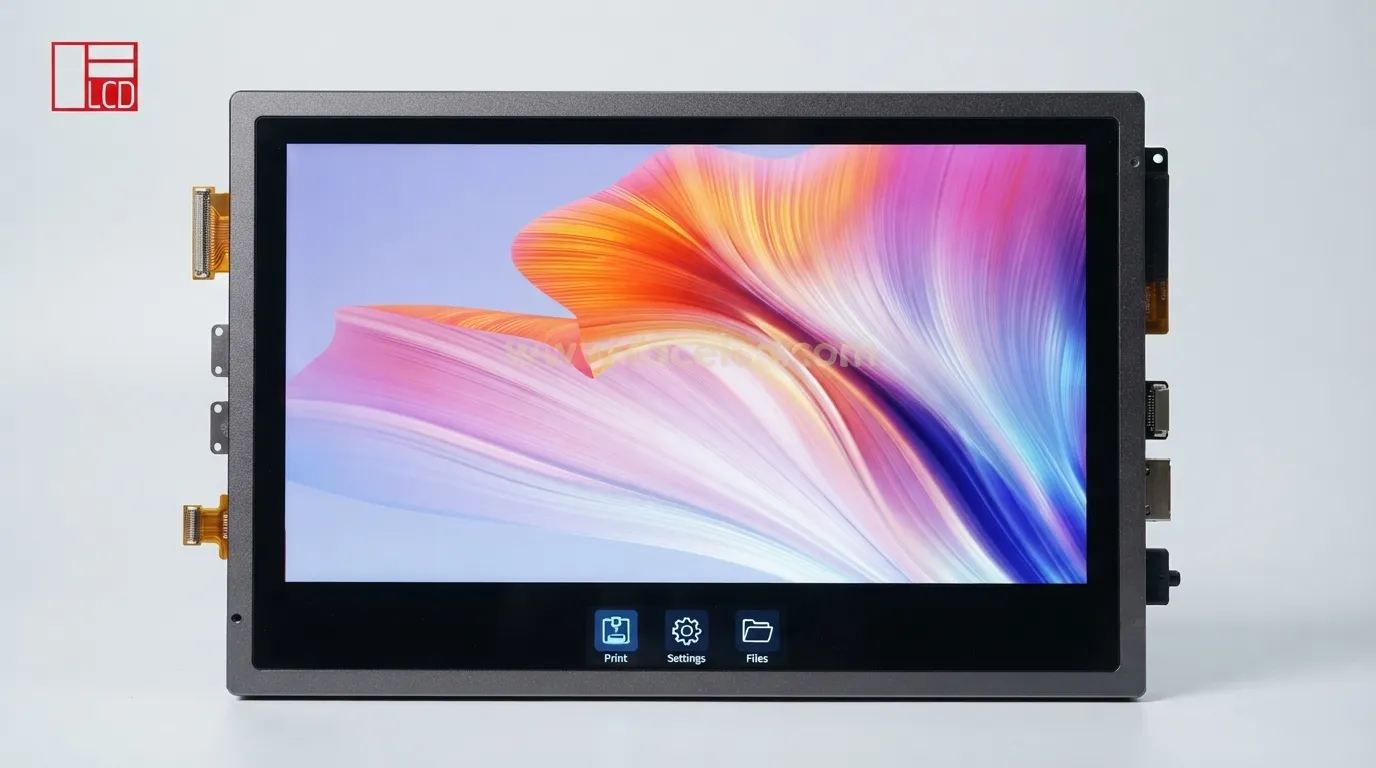
TFT LCD displays continue to be one of the most popular display technologies. A TFT LCD for a 3D printer delivers:
• High color accuracy
• Fast refresh rates
• Excellent brightness
• Sharp text rendering
• Improved graphic performance
In the case of industrial settings, an industrial TFT display is more durable and can be used in harsh environments.
An example is the 10.1-inch IPS TFT LCD of FaceLCD. The module has a 1024 x 600 resolution, 16.7 million colours, 350 cd/m 2 brightness, RGB or LVDS connections, and broad 80-degree viewing angles. It is also compatible with operating temperatures between -20 C to 70 C hence, it can be used in industrial and commercial equipment.
Most manufacturers are moving towards IPS panels due to their better image quality.
Advantages include:
• Wide viewing angles
• Better color consistency
• Improved readability
• Enhanced visual performance
A 3D printer will have an IPS display enabling the operator to see menus and process information clearly in various positions around the machine. It is particularly handy with large-format printers, production settings, and collaborative workplaces.
A 3D printer display module is a high-performance device that is made up of several integrated components. These often include:
• Printer display controller
• LCD interface board
• Touchscreen controller
• Display driver board
• Display panel for printer
• Embedded display module
The screen and the printer motherboard are usually communicated via:
• UART display module
• SPI display module
• Serial LCD
These technologies assist in developing responsive and dependable interfaces that can support sophisticated graphical user interfaces.
Touch has been a common feature in most printers. A capacitive touch display offers:
• Smooth operation
• Multi-touch support
• Smartphone-like responsiveness
• Excellent optical clarity
A resistive touch screen offers:
• Glove compatibility
• Lower cost
• Stable performance in industrial settings.
In the case of consumer printers, capacitive technology is usually favored. Depending on the conditions of operation, resistive solutions may be useful in industrial applications.
Printers have different display requirements.
FDM systems must have easy access to temperature controls, extrusion controls, and calibration devices.
Resin machines are very dependent on graphical interfaces to set exposure, prepare prints, and manage materials.
High-resolution displays of SLA printers allow precise control of the process and comprehensive feedback of the system.
In the industrial setting, solutions are needed that are rugged, have a higher level of reliability and brightness, and have a wider temperature span.
Business users are usually more concerned with touchscreen usability and sophisticated workflow management capabilities.
The technology of Human Machine Interface is gaining importance. A current 3D printer HMI display allows:
• Advanced monitoring
• Process visualization
• Remote diagnostics
• Predictive maintenance support
• Simplified workflow management
A smart touch screen interface on the 3D printer turns a complicated machine into a convenient and easy-to-use device. This is a trend that is pushing the demand towards HMI touchscreen displays of 3D printing machines.
• Smart screen on 3D printers.
• Professional 3D printer interface
• Additive manufacturing touchscreen.
• LCD solution for additive manufacturing equipment.
The quality of the display directly impacts the quality of the final product. A trusted manufacturer of 3D printer displays should provide:
• Engineering support
• Custom development
• OEM integration services
• Long-term supply stability
• Touchscreen customization
FaceLCD offers LCD modules, touch panels, LCD driver boards, monitors, and full display solutions to industrial control, medical equipment, smart home systems, transportation, and commercial applications.
Faster printers and improved materials will not be the only defining factors in the future of additive manufacturing. Smarter interfaces will also influence it. The brighter, sharper, and smarter the displays are, the more control the operators have over each step of the printing process. From a small desktop device to a big industrial production system, the 3D Printer screen can significantly enhance efficiency, precision, and user satisfaction.
If you are developing the next generation of 3D printing devices, consider collaborating with FaceLCD to develop high-quality display solutions that will make your product stand out from the crowd.