
FaceLCD Hong Kong Limited
Tel: +8615818692944
E-mail: sales@facelcd.com
Address: 13F, Buiding B, Colorful Tech Park, Guanlan High tech park, Longhua Dist, Shenzhen,China ZIP code 518100
You are here: Home > Technology >
An LCD module with touch screen is a display and a touch sensor supplied as one assembly. It combines the LCD panel and backlight, a touch panel, usually a cover glass, and the touch controller. The product designer gets a single part that shows the interface and accepts input, with the alignment and compatibility between the layers already taken care of.
These modules are also called touch screen modules, touch display modules or touch LCD modules. They are the standard choice for embedded products, industrial HMIs, medical devices and smart home panels.
| Layer | Function |
|---|---|
| Cover glass (cover lens) | The surface the user touches. It protects the module and carries any printing or logo |
| Touch sensor | Detects the touch position |
| Bonding layer | Joins the touch panel to the LCD, with air or optical adhesive |
| LCD panel | Forms the image |
| Backlight | Lights the LCD |
| Touch controller and FPC | Reads the sensor and reports coordinates to the system |
| Projected capacitive | Resistive | |
|---|---|---|
| Input | Finger, multi-touch | Finger, glove or stylus |
| Surface | Glass, scratch resistant | Film |
| Image clarity | High | Lower, because of the extra layers |
| Gloves and water | Needs tuning | Not affected |
| Typical controller interface | I2C or USB | 4-wire or 5-wire analog |
| Typical use | Modern HMIs, kiosks, consumer-style products | Industrial controls and gloved operation |
Our comparison of resistive and capacitive touch panels goes into more detail.
There are three ways to combine touch with the display, and they affect thickness, clarity and cost.
Our article on in-cell vs on-cell displays explains the difference.
With air bonding, the touch panel is attached around its edge and a small air gap remains in front of the LCD. With optical bonding, the gap is filled with clear adhesive. Optical bonding gives better contrast in bright light, prevents condensation and dust between the layers, and makes the assembly stronger. Air bonding costs less and is easier to rework. See optical bonding vs air bonding.
The FaceLCD 11.6 inch 1920×1080 IPS TFT LCD with eDP is a display that is often built into touch modules for interactive equipment. Touch integration and the cover glass can be customized.
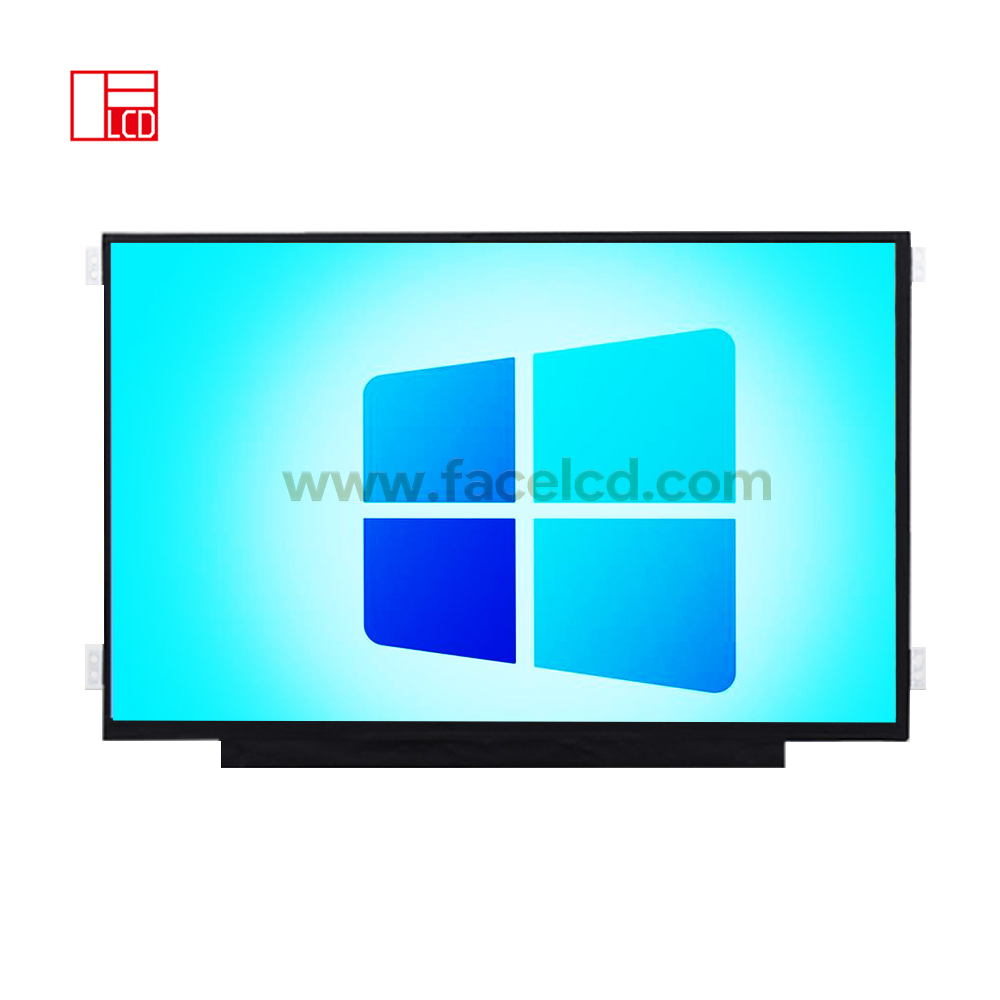
| Parameter | Value |
|---|---|
| Panel size | 11.6 inch |
| Resolution | 1920×1080 (Full HD) |
| Panel type | IPS |
| Interface | eDP |
| Colors | 16.7 million |
| Viewing angle | 85° in every direction |
| Active area | 256.32 × 144.18 mm |
| Operating temperature | -10°C to 50°C |
One practical advantage of buying the display and touch from one supplier is that the two parts are already matched. These FaceLCD touch panels are made for specific LCD modules:
| LCD | Matching touch panel | Touch type |
|---|---|---|
| AT043TN24 V.7, 4.3 inch | 4.3 inch touch panel | Resistive |
| AT043TN25 V.2, 4.3 inch | 4.3 inch GT911 touch panel | Capacitive, I2C |
| Tianma TM050RDH03-41, 5 inch | 5 inch G+G touch panel | Capacitive |
| AT070TN92 V.1, 7 inch | 7 inch touch panel | Capacitive |
| AT070TN94, 7 inch | 7 inch 4-wire touch panel | Resistive |
| G104STN01.0, 10.4 inch | 10.4 inch GT928 touch panel | Capacitive |
| INNOLUX G121XCE-L01, 12.1 inch | 12.1 inch touch panel | Capacitive |
| INNOLUX G150XNE-L03, 15 inch | 15 inch 4-wire touch panel | Resistive |
Ready-made assemblies are listed under touch LCD displays, and complete units with a driver board under open frame monitors.
A touch panel is the sensor only. A touch screen module includes the display as well. See touch screen vs touch panel.
In most cases, yes, provided a touch panel with a matching active area is available or can be made. The housing also needs room for the extra thickness.
Both are used. Resistive touch is simple and works with any glove. Capacitive touch gives a glass front and multi-touch, and can be tuned for gloves and water.
Yes. Check that a driver is available for your operating system. Common controllers are widely supported on Android and Linux.
Yes. Shape, thickness, printing, logo and surface treatment can all be specified.
FaceLCD supplies LCD modules, capacitive and resistive touch panels and complete bonded assemblies. Contact us with your size, interface and touch requirements.