
FaceLCD Hong Kong Limited
Tel: +8615818692944
E-mail: sales@facelcd.com
Address: 13F, Buiding B, Colorful Tech Park, Guanlan High tech park, Longhua Dist, Shenzhen,China ZIP code 518100
You are here: Home > Technology >
A Color LCD Display Module may be described as TFT, IPS, TN, or a combination of these terms. However, TFT, IPS, and TN do not represent the same technical layer.
TFT refers to the active-matrix circuit used to control individual pixels. IPS and TN describe how liquid crystal molecules are arranged inside the LCD cell. Therefore, a Color LCD Display Module can use either an IPS TFT structure or a TN TFT structure.
For engineers and equipment manufacturers, the practical comparison is not simply "TFT vs. IPS." The more accurate comparison is TN TFT vs. IPS TFT, together with brightness, interface, operating temperature, touch structure, and mechanical compatibility.
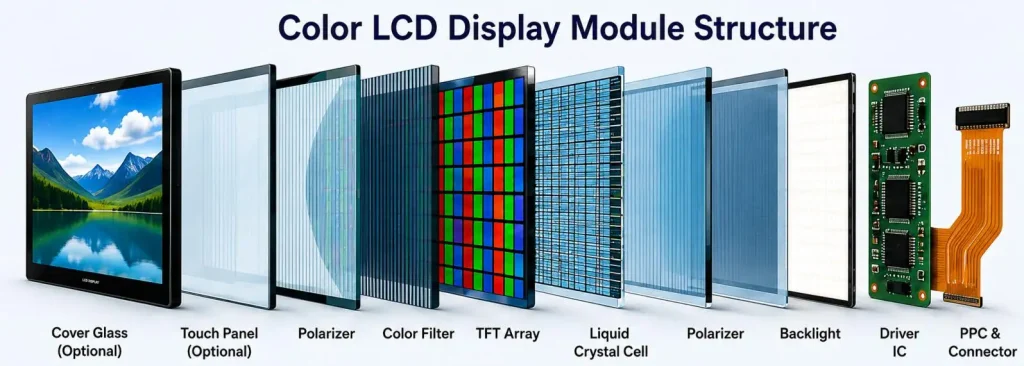
A Color LCD Display Module is an integrated optical and electronic assembly rather than only a piece of LCD glass. Its main components work together to produce images, text, menus, alarms, and graphical user interfaces.
| Module Component | Technical Function | Effect on Performance |
| TFT array | Electrically addresses individual subpixels | Resolution, refresh stability and grayscale control |
| Liquid crystal cell | Controls light transmission | Response time, contrast and viewing angle |
| RGB color filter | Creates red, green and blue subpixels | Color reproduction and color gamut |
| Polarizers | Control light orientation | Contrast and screen visibility |
| LED backlight | Illuminates the LCD cell | Brightness, power consumption and heat |
| Driver IC | Generates gate and source signals | Timing, resolution and interface compatibility |
| FPC and connector | Connect the module to the mainboard | Pin assignment and mechanical integration |
| Touch panel | Provides user input | Optical clarity and operating method |
Optional components may include cover glass, optical bonding, mounting frames, custom backlights, controller boards, and capacitive or resistive touch panels.
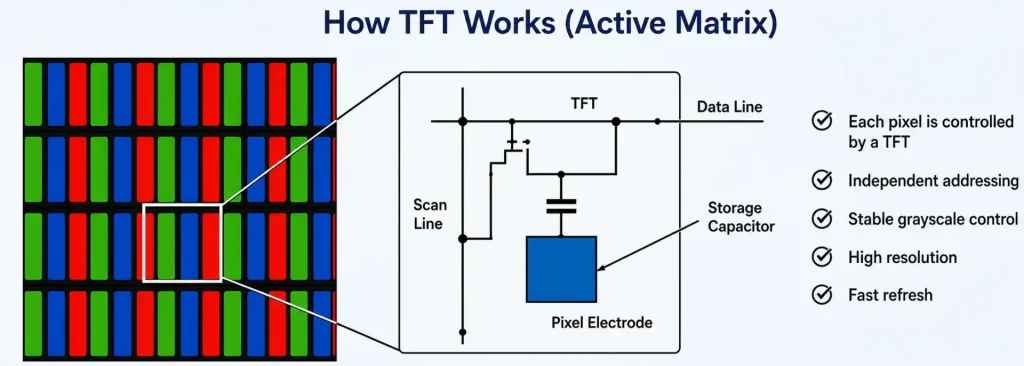
TFT stands for Thin-Film Transistor. In active-matrix TFT LCDs, each pixel has transistors controlling its subpixels. The TFT holds and allocates the charge to the liquid crystal for the duration of the refresh cycle.
This structure provides:
• Independent pixel addressing
• Stable grayscale transitions
• Higher pixel density
• Faster image refresh
• Reduced crosstalk between adjacent pixels
• Better control of complex graphics
TFT is therefore the pixel-driving architecture. IPS and TN are electro-optical modes used within the LCD cell.
TFT controls the pixels, while IPS and TN determine how the liquid crystal molecules rotate to control transmitted light.
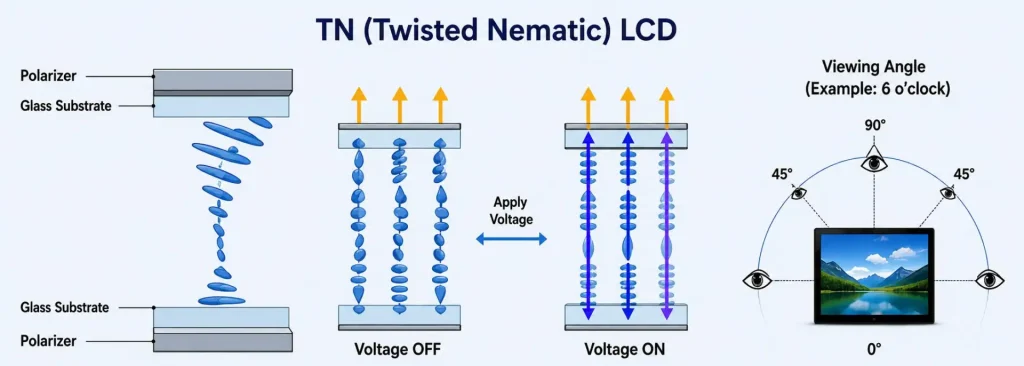
TN means Twisted Nematic. In a TN LCD cell, the liquid crystal molecules form a twisted structure between two substrates. When voltage is applied, the molecular orientation changes and modifies how polarized light passes through the panel.
• Fast liquid crystal response
• Mature and cost-efficient production
• Relatively high optical transmission
• Lower backlight demand in many designs
• Clear images at the specified viewing direction
• Possible color or grayscale inversion at oblique angles
A TN TFT Color LCD Display Module often specifies a preferred viewing direction:
• 6 o'clock: optimized for viewing from below
• 12 o'clock: optimized for viewing from above
• 3 o'clock or 9 o'clock: optimized for side viewing
TN TFT is often selected for handheld instruments, measurement devices, small controllers, keypad displays, and equipment operated from a fixed position.
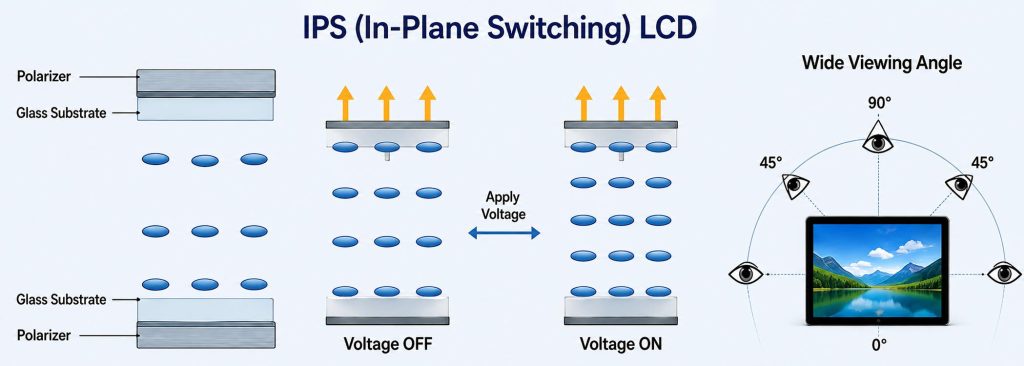
IPS stands for In-Plane Switching. In an IPS LCD cell, the liquid crystal molecules rotate mainly parallel to the glass substrates. This reduces the optical variation that occurs when the display is viewed from different directions.
• Almost 180-degree horizontal and vertical viewing angles
• Color shift with viewing angle is negligible
• Contrast is maintained for a variety of viewing angles
• Various angles improve the readability of graphs, images, and HMI illustrations
• Display performance is consistent when rotating the display from landscape to portrait
IPS TFT Color LCD Display Modules are typically found in Industrial HMI panels, Medical Instruments, Automotive Displays, Smart Home Controllers, Inspection Instruments, and Commercial Terminals.
Additional Structures result in lower optical transmission and increased costs, therefore, increased lighting and consequently increased power consumption and thermal design problems from a higher LED junction temperature and increased flux are necessitated.
| Performance Factor | TN TFT LCD | IPS TFT LCD |
| Pixel driving | TFT active matrix | TFT active matrix |
| LC alignment | Twisted Nematic | In-Plane Switching |
| Viewing angle | Direction-dependent | Wide and symmetrical |
| Color stability | May shift at steep angles | Stable across wider angles |
| Response time | Generally fast | Depends on panel design |
| Optical transmission | Often higher | May be lower in some designs |
| Backlight requirement | Usually moderate | May require higher output |
| Cost | Generally lower | Generally higher |
| Suitable interface | Simple UI and fixed viewing | Graphics-rich and multi-angle viewing |
| Typical use | Meters and handheld devices | HMI, medical and automotive systems |
IPS should not automatically be considered superior. A well-designed TN TFT Color LCD Display Module may provide lower power consumption, faster response, and better cost control when the operator's viewing position is predictable.
An IPS label does not guarantee superior overall image quality. Final display performance depends on the entire optical stack and driving system.
Important specifications include:
• Native resolution and pixel density
• Static contrast ratio
• Backlight uniformity
• NTSC or sRGB color coverage
• Gamma curve and white-point consistency
• Polarizer quality
• Driver IC configuration
• Surface haze and reflectance
• Air bonding or optical bonding
• Controller-board signal quality
For example, an IPS Color LCD Display Module with low brightness, poor backlight uniformity, or incorrect gamma settings may perform worse than a properly calibrated TN module in a fixed-viewing application.
Typical brightness ranges include:
• 250–400 nits: indoor instruments and control panels
• 500–800 nits: bright indoor and semi-outdoor equipment
• 1,000 nits or more: sunlight-readable applications
Outdoor visibility also depends on surface reflection, touch-panel transmission, cover-glass treatment, and optical bonding. High brightness alone does not guarantee sunlight readability.
Common interfaces include MCU, SPI, RGB, LVDS, MIPI DSI, eDP, and HDMI. Engineers must verify:
• Logic voltage
• Pixel clock
• Data-lane configuration
• Horizontal and vertical timing
• Connector pinout
• Backlight input
• Driver-board compatibility
Two modules with the same size and resolution may not be electrically interchangeable.
Industrial projects should evaluate:
• Slower liquid crystal response at low temperatures
• Contrast changes at high temperatures
• LED backlight life
• Polarizer durability
• Storage-temperature limits
• Condensation and thermal cycling
Capacitive touch technology allows for multi-touch and smooth fingertip interactions through cover glass. Resistive touch technology allows for input via pressure (which can be applied by a stylus or by wearing gloves). Optical bonding helps reduce internal reflections, and the optical bond may help improve the strength of the assembly.
There are many factors to consider before choosing a Color LCD Display Module. These include:
• Dimensions of the active area and the module
• Viewing angles, resolution, and pixel pitch
• Actual angle of viewing by the operator
• Choice of a TN or IPS display
• Requirement of a display that is high brightness and sunlight readable or that is an indoor display
• Choice of display touch technology (capacitive, resistive or none)
• Operating temperatures and temperatures for storage
• Mounting area for the connector, FPC, and bond area
• Performance of the display samples with the final design of the main board and the enclosure
Most suitable choice is a TN display when cost, the need for fast display response time, low display backlighting, and fixed angles of viewing are the main concerns. Choose an IPS display when the requirements are for wide viewing angles, complex and stable colors, and detailed graphics.
A Color LCD display module can be best defined when the technology of the display panel is integrated with the optical, electrical, thermal, and mechanical specifications of the system.
For Color LCD Display Module solutions for industrial control systems, medical devices, automotive electronics, smart home products, inspection devices, security terminals, commercial HMI displays, and embedded HMI solutions, FaceLCD is your supplier of choice.
Panel options for custom displays range from 0.96" to 49" with resolutions spanning from QVGA to Full HD. Structures can be TN or IPS. Brightness can be standard or high. Panel interfaces can be any of MCU, RGB, LVDS, MIPI, eDP, or HDMI. Projects can also include capacitive or resistive touch, custom FPCs, cover glass, backlights, optics bonding, and driver boards.
FaceLCD can help clients determine display size, interfaces, touch structures, and more. Sample selection is the next step after the preliminary technical matching. This process is to reduce layout changes of the mainboard, to reduce changes of the enclosure, and to reduce risks of display compatibility throughout the product development process.
Q1. Are IPS and TN Color LCD Display Modules Provided by FaceLCD?
FaceLCD indeed provides TN and IPS TFT display modules. Compared to TN, IPS panels are a better choice for applications requiring different viewing angles and where color stability is important.
Q2. What Sizes of Color LCD Display Module Does FaceLCD Offer?
FaceLCD provides Color LCD Display Modules from 0.96 inch to 49 inch. Offered sizes are suitable for hand-held devices, embedded terminals, industrial HMI panels, medical and automotive devices, as well as various commercial and industrial displays.
Q3. Will FaceLCD Guide to Select Either IPS or TN Display?
Certainly, FaceLCD will assess viewing angles of the equipment, the position of the users, how images will be displayed, as well as the restrictions regarding power and budget in order to suggest the most appropriate IPS or TN Color LCD Display Module.
Q4. Which Interfaces Does FaceLCD Offer?
Depending on the size of the panel, its resolution and the type of controller, FaceLCD offers solutions for interfaces such as MCU, SPI, RGB, LVDS, MIPI DSI, eDP and HDMI. Before sampling, interface flexibility, and compatibility with the mainboard should be checked.
Q5. Can FaceLCD Modify the FPC and Its Connector Position?Yes. Some of the selected projects can have custom length and shape of FPC as well as its pin definition, bending direction, and position of the connector. To ensure feasibility, design should be provided as early as possible