
FaceLCD Hong Kong Limited
Tel: +8615818692944
E-mail: sales@facelcd.com
Address: 13F, Buiding B, Colorful Tech Park, Guanlan High tech park, Longhua Dist, Shenzhen,China ZIP code 518100
You are here: Home > Technology >
Choosing a custom touch screen manufacturer involves more than comparing panel sizes and unit prices. A touch panel must fit the LCD, enclosure, PCB, cable route, operating system, and real working environment. A small error in the cover glass, active area, FPC direction, connector, or controller can delay the entire product.
FaceLCD is a direct manufacturer rather than a trading company. Founded in 2009, the company operates factories in Shenzhen and Dongguan and exports display products to more than 40 countries. Its manufacturing scope includes custom touch panels, LCD modules, driver boards, monitors, and integrated LCD machines.
This vertically integrated model allows FaceLCD to review the touch panel as part of the complete display system—not as an isolated component.
Send your LCD model, mechanical drawing, and application requirements to FaceLCD for an engineering review and quotation.
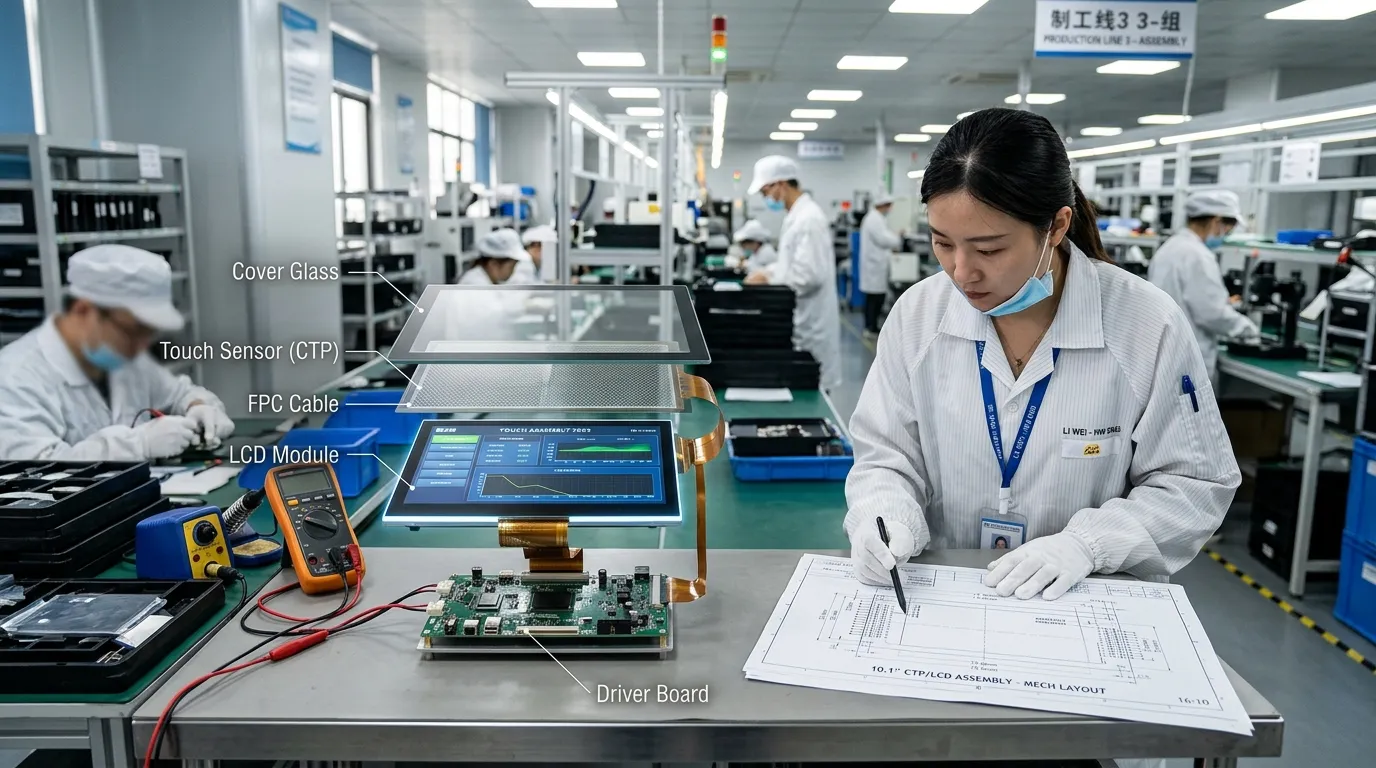
A standard touch panel may work when the enclosure, LCD, connector, and controller are flexible. However, many OEM products require a panel designed around an existing mechanical and electrical structure.
A custom project may be necessary when:
FaceLCD reviews these requirements before sample production. This helps identify compatibility risks while the design can still be adjusted.
FaceLCD supports both individual touch-panel customization and broader touch-display integration. The exact structure depends on the application, LCD, enclosure, interface, and required operating conditions.
Projected capacitive touch panels are commonly selected for glass-front products, multi-touch interfaces, kiosks, smart-home controls, medical equipment, and modern industrial HMIs.
Resistive touch panels remain suitable for applications that use pressure input, passive styluses, or certain types of gloves.
The correct choice should be based on the real input method and operating environment—not only appearance or price.
FaceLCD can review mechanical requirements such as:
The buyer should provide a mechanical drawing whenever possible. An enclosure drawing is especially useful when the glass outline, mounting structure, and internal cable space are already fixed.
The touch interface must communicate correctly with the product’s mainboard. Depending on the project, FaceLCD can review requirements involving I²C, USB, SPI, or another suitable interface.
The engineering review may also consider:
Software and controller requirements should be discussed before sampling. A mechanically correct touch screen can still fail if the interface or driver does not match the product platform.
Using separate suppliers for the touch panel, LCD, and driver board can create responsibility gaps. When a compatibility problem appears, each supplier may confirm that its own component works independently.
FaceLCD’s integrated product scope allows the engineering team to review:
This does not remove every engineering risk, but it can reduce coordination problems between disconnected suppliers.
| Project Element | Possible FaceLCD Support | Information Needed from Buyer |
|---|---|---|
| Touch technology | Capacitive or resistive selection | Application and input method |
| Cover glass | Size, thickness, printing, and fit review | Mechanical or enclosure drawing |
| Sensor area | Alignment with the selected LCD | LCD model or datasheet |
| FPC and connector | Direction, length, and connector review | PCB layout and available space |
| Interface | I²C, USB, SPI, or project-specific review | Mainboard specification |
| Bonding | Air or optical bonding evaluation | Optical and structural requirements |
| Environmental operation | Glove, water, EMI, and thick-glass discussion | Actual operating conditions |
| Complete assembly | Touch, LCD, and driver coordination | System architecture and project scope |
A sourcing website alone does not prove that the supplier operates its own production facilities.
Ask for:
FaceLCD operates factories in Shenzhen and Dongguan and has manufactured display products since 2009. Buyers can evaluate its production and workshop evidence instead of relying only on a sales listing.
A custom touch-screen project may involve more than the sensor and cover glass. The supplier may also need to understand the LCD, driver board, housing, controller, and bonding method.
FaceLCD manufactures and supplies touch panels, LCD modules, driver boards, monitors, and integrated display machines. This broader scope is useful when the project requires a matched display assembly rather than a standalone touch component.
A qualified manufacturer should ask technical questions before confirming the design or price.
The supplier should review:
A quotation prepared without this information may be based on assumptions that change later.
FaceLCD reviews drawings, display information, mechanical fit, interface requirements, and application conditions before moving toward a sample.
“Customizable” is too broad unless the supplier explains exactly what can be changed.
A buyer should confirm whether the manufacturer can support the required:
FaceLCD prepares the proposed structure according to the project. Final capability should always be confirmed against the drawing and technical requirements.
A sample should represent the intended production design closely enough for meaningful testing.
Before approval, the buyer should evaluate:
Any necessary revisions should be completed before the design is frozen for production.
The approved sample alone is not enough. The manufacturer and buyer should confirm which documents and reference standards control production.
These may include:
The exact documentation depends on the project, but the requirements should be clear before repeat production begins.
Overseas OEM projects require more than manufacturing capability. The supplier must also manage technical communication, document exchange, sample shipping, revisions, and repeat orders.
FaceLCD exports to more than 40 countries. Buyers should still confirm the communication process, delivery terms, documentation, issue-resolution procedure, and long-term production requirements for their own project.
| Evaluation Criterion | What the Buyer Should Verify | FaceLCD Fit |
|---|---|---|
| Direct manufacturing | Factory and production evidence | Shenzhen and Dongguan manufacturing operations |
| Integrated capability | Touch, LCD, board, and bonding coordination | Multiple display-product categories under one supplier |
| Engineering review | Drawing, interface, and housing checks | Project review before sampling |
| Customization | Exact mechanical and electrical options | Project-specific structure and component review |
| Sample validation | Testing and revision process | Engineering sample before production approval |
| Production control | Approved specifications and references | Requirements confirmed before mass production |
| Export support | Communication and overseas supply experience | Exports to more than 40 countries |
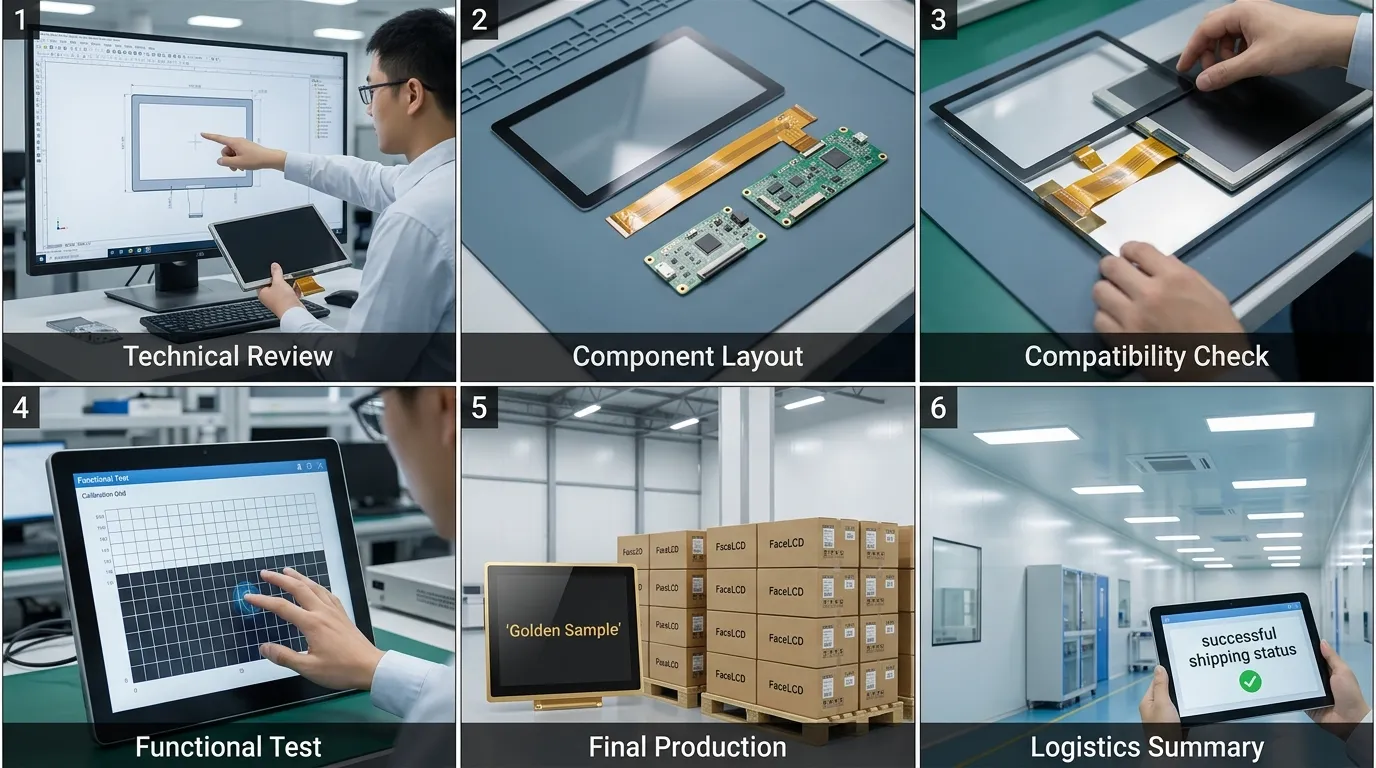
The project begins with the end application and system requirements.
FaceLCD may request:
Clear information at this stage helps avoid proposals that do not match the final product.
The engineering team reviews the supplied files and component relationships.
This can include:
Missing details are identified before the sample structure is confirmed.
FaceLCD prepares a proposed structure based on the reviewed requirements.
The proposal may define:
The buyer should review both the technical proposal and the quotation before approving the sample.
FaceLCD produces the agreed engineering sample. The sample allows the buyer to test the panel inside the actual product rather than evaluating it only from a drawing.
The buyer installs and tests the sample under realistic conditions.
Testing should cover the functions relevant to the application, such as:
If revisions are needed, the drawing and technical structure should be updated before production approval.
Once the sample passes validation, the buyer and FaceLCD confirm the final specification, production quantity, inspection requirements, packaging, and delivery plan.
| Stage | FaceLCD Activity | Buyer Activity | Output |
|---|---|---|---|
| Requirement review | Evaluate project information | Supply specifications and drawings | Initial feasibility |
| Engineering review | Check touch, LCD, interface, and housing | Answer technical questions | Proposed structure |
| Proposal | Prepare technical and commercial solution | Confirm project scope | Approved quotation basis |
| Sampling | Produce engineering samples | Install and test samples | Test units |
| Validation | Review issues and revisions | Complete product-level testing | Approved design |
| Production | Manufacture to approved requirements | Confirm order and delivery needs | Production units |
A panel may fail to fit even when its nominal screen size appears correct. FaceLCD can review the cover-glass outline, active area, LCD alignment, housing clearance, FPC direction, and connector position.
The touch controller, interface, operating voltage, driver, and coordinate orientation must match the mainboard. These items should be confirmed before sampling, especially for embedded Linux, Android, Windows, or custom systems.
Industrial and outdoor projects may require operation with gloves, water drops, thick cover glass, electrical noise, or temperature changes. These conditions must be stated clearly because they can affect the sensor structure, controller, firmware, grounding, and testing plan.
When the touch panel, LCD, driver board, and bonding service come from different suppliers, compatibility issues may take longer to resolve. FaceLCD’s integrated model allows more of these elements to be reviewed within one project.
FaceLCD’s custom touch-screen manufacturing services may suit:
Application suitability depends on the confirmed touch technology, LCD, controller, environment, and required testing.
A detailed RFQ helps the engineering team evaluate the project accurately.
Send as much of the following information as possible:
Have only an LCD model and enclosure drawing? FaceLCD can use these as the starting point for an initial touch-panel matching review.
Request a technical review and sample quotation before finalizing the front-panel design.
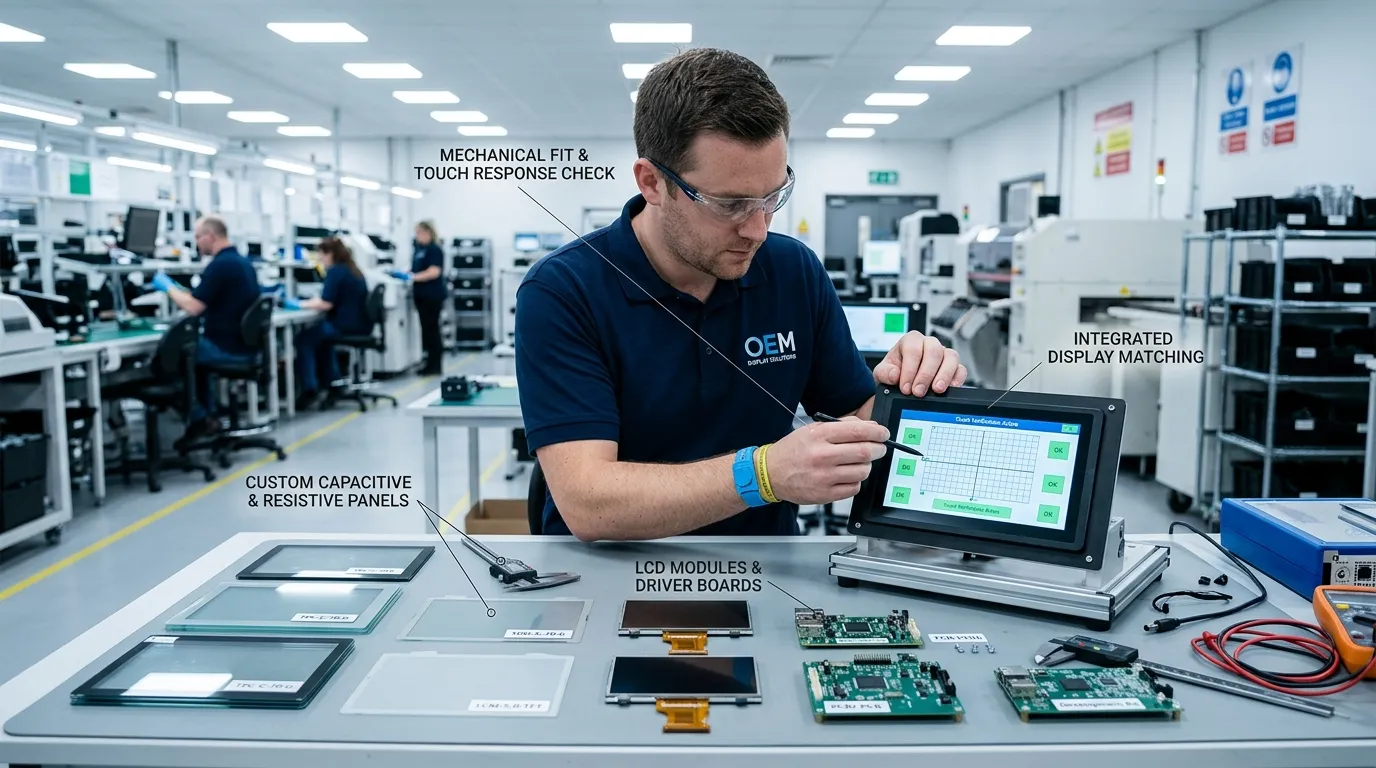
FaceLCD combines touch-panel manufacturing with a broader display-product scope. This is useful for OEM buyers who need engineering coordination across the touch screen, LCD, driver board, bonding, and enclosure.
Relevant trust points include:
Buyers should request production images, workshop evidence, drawings, sample records, and project-specific documentation during supplier qualification. Real evidence is more useful than broad claims such as “high quality” or “professional manufacturer.”
Yes. FaceLCD supports capacitive and resistive touch-panel projects. The correct type depends on the application, input method, cover structure, and operating environment.
Yes, subject to engineering review. Send the LCD model, datasheet, active area, viewing area, mechanical drawing, and enclosure information so the touch structure can be evaluated.
Depending on the project, customization may include the cover-glass dimensions, thickness, printing, sensor area, FPC direction, cable length, connector, interface, controller, and bonding method.
Provide the LCD datasheet, touch or cover-glass drawing, enclosure drawing, PCB or interface information, application details, operating conditions, and expected order quantity.
These requirements can be evaluated, but performance depends on the touch controller, firmware, glass thickness, grounding, product structure, and actual environment. They should be specified before sampling.
A custom project normally includes an engineering-sample stage so the buyer can validate mechanical fit, touch performance, interface communication, and application-specific requirements before production approval.
FaceLCD manufactures touch panels, LCD modules, driver boards, monitors, and integrated display products. The exact supply scope should be confirmed according to the project architecture.
Send FaceLCD the LCD model, mechanical drawing, cover-glass requirements, interface, operating environment, and estimated quantity. The engineering team can review feasibility and prepare the proposed sample scope.
Send FaceLCD your LCD model, cover-glass or enclosure drawing, interface requirements, application conditions, and expected quantity. The engineering team will review the touch structure, mechanical fit, controller requirements, and integration scope before preparing a custom quotation.
Request a custom touch-screen quote, send your drawing for review, or discuss your OEM/ODM project with FaceLCD.