
FaceLCD Hong Kong Limited
Tel: +8615818692944
E-mail: sales@facelcd.com
Address: 13F, Buiding B, Colorful Tech Park, Guanlan High tech park, Longhua Dist, Shenzhen,China ZIP code 518100
You are here: Home > Technology >
FaceLCD supplies wholesale capacitive touch panels for OEM and ODM projects that require custom dimensions, cover glass, FPC routing, interfaces, touch functions, and LCD compatibility. The service is designed for equipment manufacturers, product developers, system integrators, and buyers preparing for repeat production rather than one-off consumer purchases.
A wholesale project normally starts with a drawing, LCD model, application details, interface requirements, sample quantity, and expected production volume. FaceLCD reviews these inputs before confirming the panel structure, customization route, MOQ, quotation, sample process, and production lead time.
To discuss a project, send FaceLCD your LCD model or drawing, required dimensions, interface, cover-glass requirements, and forecast quantity through the contact page.
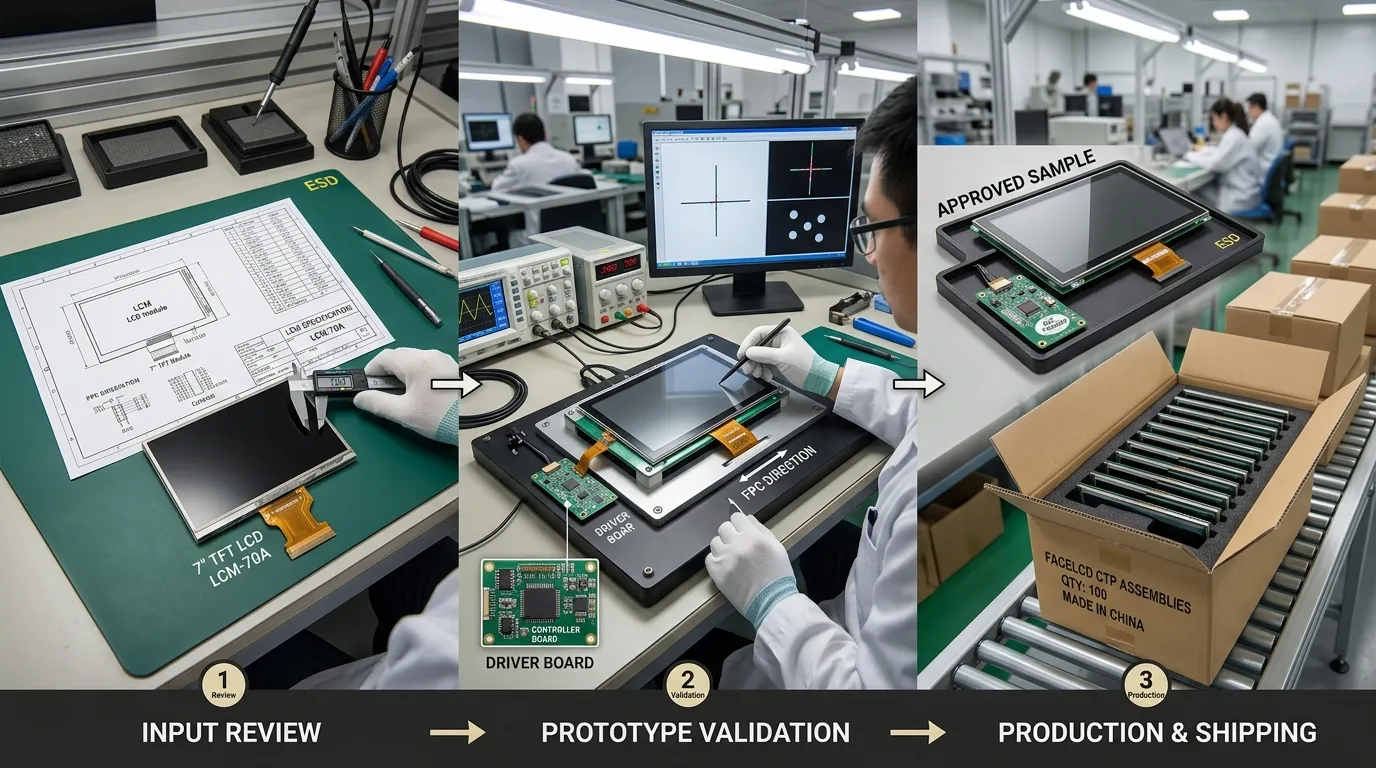
FaceLCD supports projected capacitive touch panel configurations for industrial, commercial, medical, security, smart-home, automotive, inspection, and other electronic equipment.
The company’s capacitive touch panel options include different structures, interfaces, touch-point configurations, and custom mechanical designs.
Available project directions include:
The correct structure depends on the product’s durability requirements, available installation space, cover-glass design, target cost, and operating environment.
FaceLCD can review these requirements and recommend a suitable configuration rather than asking the buyer to select a structure without engineering input.
FaceLCD can support common touch interfaces such as:
The interface must match the buyer’s mainboard, controller, operating system, and connector layout. FPC direction, cable length, pin definition, and connector position should therefore be confirmed before sample production.
For OEM and ODM equipment, the touch panel often needs to match an existing housing rather than use a standard rectangular outline.
Customizable areas may include:
Buyers should provide a mechanical drawing or enclosure dimensions whenever possible. This allows FaceLCD to review the cover-glass outline, active area, LCD viewing area, and available installation space together.
Depending on the controller, cover-glass stack, environment, and application, FaceLCD can review requirements for:
These functions are project-specific. They should be stated in the initial RFQ because they can affect the controller selection, tuning work, sample process, MOQ, price, and schedule.
| Configuration Area | Available Direction | Information Needed From Buyer |
|---|---|---|
| Touch structure | G+G, G+F, F+F | Application, strength and thickness requirements |
| Touch points | Five-point, ten-point or project-based | User interface and operating-system needs |
| Interface | I2C, USB, SPI or custom connection | Mainboard, pin definition and connector details |
| Cover glass | Custom size, thickness and printing | Drawing, artwork and housing dimensions |
| FPC | Custom direction, length and connector | PCB and enclosure layout |
| Special functions | Glove touch, water touch and thicker glass | Operating environment and use conditions |
| Display integration | LCD matching and bonding | LCD model or LCD drawing |
FaceLCD’s wholesale capacitive touch panel service is suitable for buyers who need a panel developed or adjusted for a specific product.
Typical buyers include:
A project is usually a good fit when the buyer can provide a clear application, mechanical requirements, electrical interface, expected quantities, and a sample-validation plan.
Buyers that also need an LCD module, driver board, bonding, or wider display integration can review FaceLCD’s broader custom touch panel solutions.
Wholesale sourcing is not only about choosing a panel size and requesting a unit price. A reliable order requires mechanical, electrical, optical, and commercial details to be confirmed before mass production.
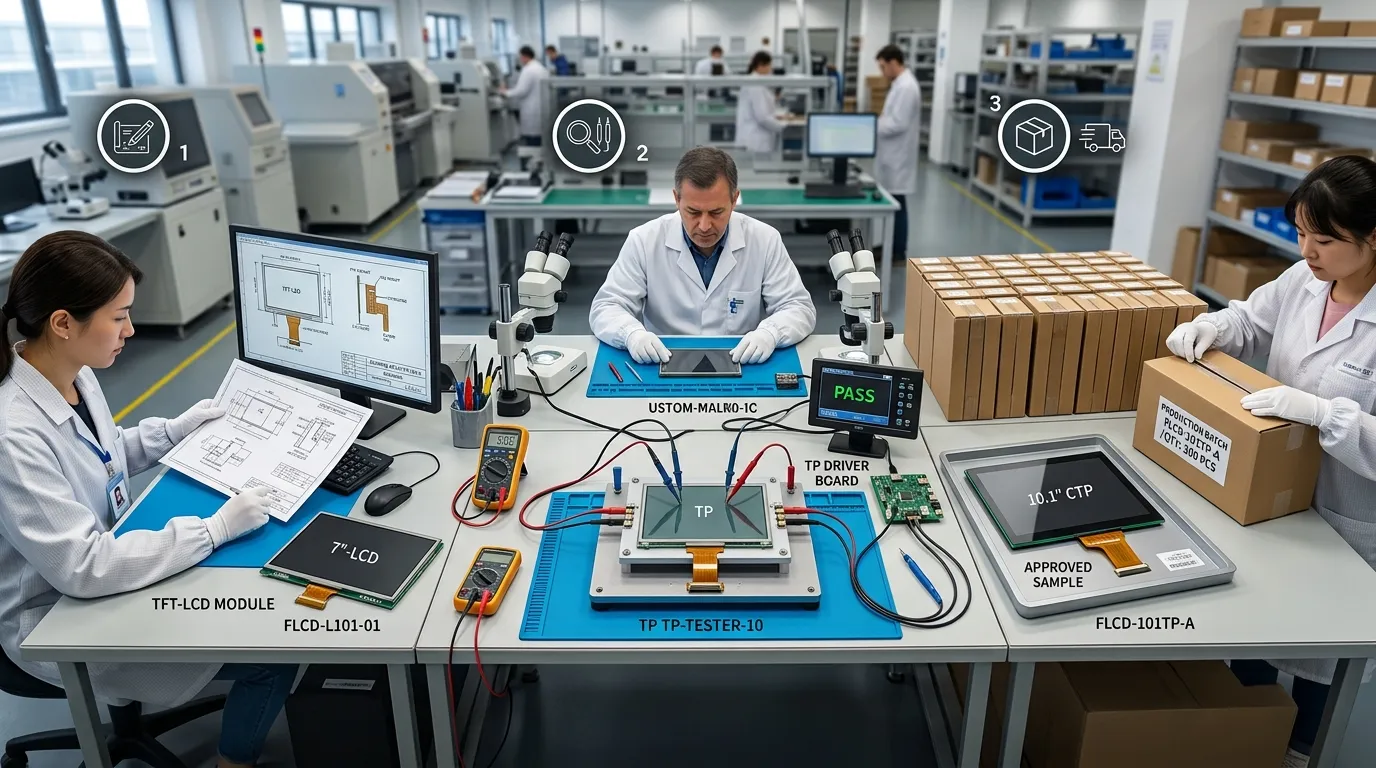
The initial inquiry should include as much of the following information as possible:
A complete RFQ allows FaceLCD to evaluate the project more accurately and reduces repeated clarification before quotation.
FaceLCD reviews the proposed touch panel as part of the equipment assembly.
The review may include:
This stage is important because a panel can function electrically while still being unsuitable for the enclosure, LCD, PCB, or final user interface.
After reviewing the requirements, FaceLCD can confirm the proposed product configuration and commercial route.
The quotation should clarify:
MOQ is not identical for every project. A standard or existing design may have different requirements from a fully customized panel with new glass, printing, FPC, connector, controller, or tuning work.
Before sample production, the buyer should approve the final project details.
These may include:
Approval should be documented. This reduces the risk of producing a sample based on an outdated drawing or incomplete requirement.
The engineering sample should be tested inside the intended device rather than only on a workbench.
The buyer should validate:
A sample should not move into bulk production until the buyer has completed the required tests.
If testing identifies a problem, the change should be recorded and reviewed before another sample or mass production.
Possible revisions may involve:
The final approved drawing and sample should become the production reference.
After approval and purchase-order confirmation, the project can move into mass production.
FaceLCD’s production checks can include:
Buyers can view FaceLCD’s production equipment and factory environment when evaluating its manufacturing capabilities.
| Stage | Buyer Provides or Approves | FaceLCD Reviews or Delivers | Output |
|---|---|---|---|
| RFQ | Application, drawing, LCD and quantity | Initial feasibility | Requirement summary |
| Engineering review | Mechanical and electrical details | Compatibility and structure review | Proposed configuration |
| Quotation | Forecast and schedule | MOQ, price and lead time | Commercial quotation |
| Drawing approval | Written approval | Final production documents | Approved specification |
| Sample | Test requirements | Engineering sample | Validation unit |
| Validation | Test results and revisions | Adjustment support | Final approved design |
| Bulk production | Purchase order | Manufacturing and inspection | Production batch |
| Shipment | Delivery information | Packing and export preparation | Wholesale delivery |
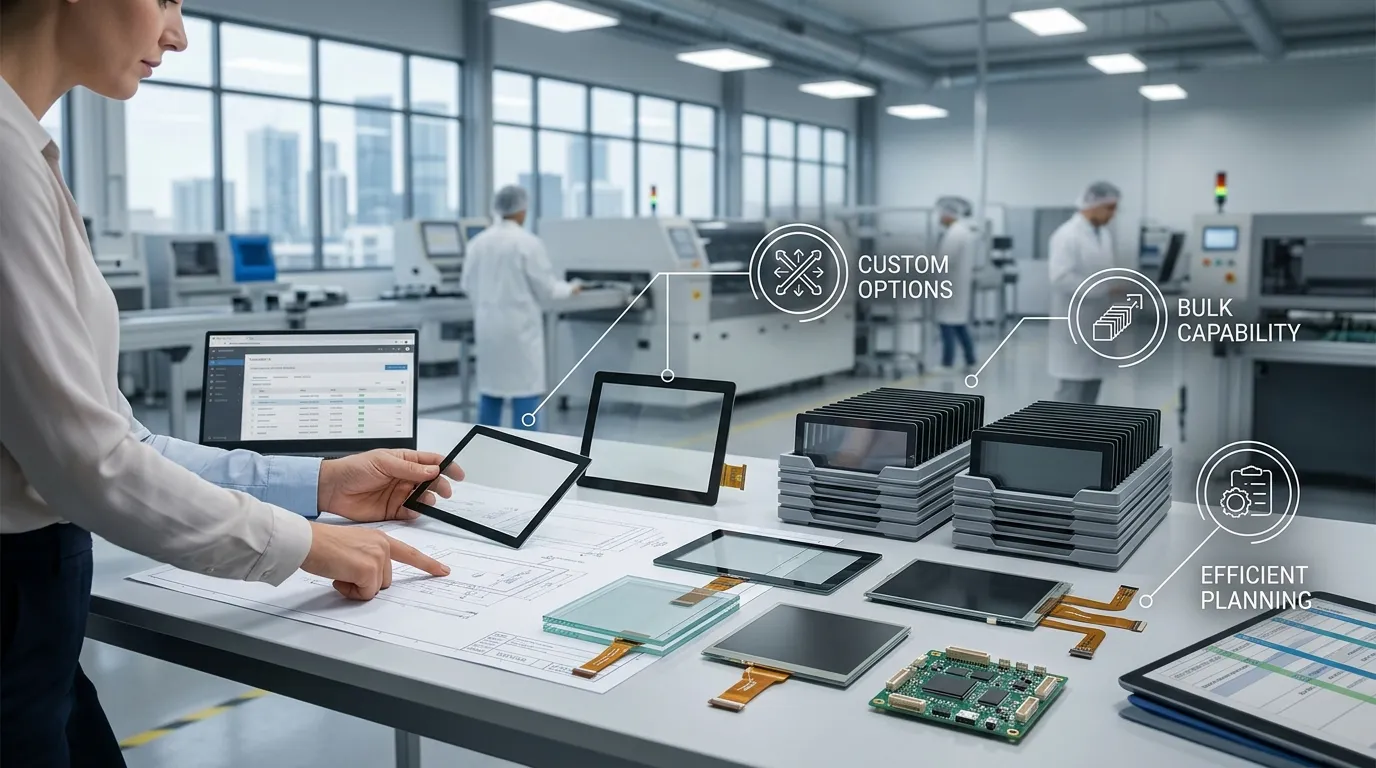
FaceLCD confirms MOQ after reviewing the design and order plan.
MOQ may be affected by:
Sample MOQ and mass-production MOQ may also be different. Buyers should provide both the required development quantity and expected production quantity when requesting a quote.
The main quotation variables include:
Comparing suppliers only by unit price can hide differences in customization, controller configuration, inspection, sample support, and display compatibility.
The project schedule may include separate periods for:
Lead time should be confirmed against the actual design and quantity. A standard panel and a new custom panel should not be expected to follow the same schedule.
| Order Variable | Possible Effect on MOQ | Possible Effect on Price | Possible Effect on Lead Time |
|---|---|---|---|
| Existing design | May support a lower entry quantity | Lower development requirement | Usually less preparation |
| New custom glass | Project-specific MOQ | Printing or tooling may apply | Requires drawing and sample work |
| Custom FPC | Depends on design | Engineering and material cost | Requires confirmation |
| Special controller or tuning | Project-dependent | Controller and development cost | Adds testing time |
| Optical bonding | Depends on assembly | Additional material and process cost | Adds assembly work |
| Larger forecast quantity | Supports production planning | May improve volume efficiency | Requires capacity planning |
Many touch panel problems begin before production. Incorrect dimensions, FPC direction, connector position, or active-area alignment can force changes to the enclosure, PCB, or LCD assembly.
FaceLCD reduces these risks by reviewing the touch panel together with the wider display and device requirements.
The process can help identify:
The sample stage then gives the buyer an opportunity to test the actual panel before committing to a production batch.
FaceLCD supplies LCD modules, touch panels, LCD driver boards, monitors, and complete display solutions. This allows buyers to review the touch panel as part of the full display assembly rather than source each component without compatibility support.
FaceLCD supports capacitive and resistive touch technologies, custom cover glass, FPC routing, connector matching, interface selection, LCD fit review, bonding, and project-based sample development.
This is useful for OEM and ODM buyers whose products cannot use an unchanged catalog panel.
FaceLCD operates manufacturing facilities in Shenzhen and Dongguan. Its factory materials show production lines, laminating facilities, screen-printing equipment, cutting equipment, and a dust-controlled working environment.
This gives buyers more evidence than a product listing alone when evaluating a factory-direct supplier.
FaceLCD states that it exports display products to more than 40 countries across Europe, Asia, Oceania, North America, and South America.
For overseas wholesale buyers, this experience is relevant to communication, order preparation, packing, documentation, and repeat supply.
For an initial review, send:
For a more detailed quotation, also provide:
Clear project information allows FaceLCD to confirm feasibility, configuration, MOQ, pricing, sampling, and lead time more efficiently.
MOQ depends on whether the panel uses an existing design or requires custom glass, FPC, printing, controller selection, bonding, or special tuning. FaceLCD confirms the sample and production MOQ after reviewing the project requirements and forecast quantity.
Yes. OEM and ODM projects should normally begin with engineering samples. The buyer can test mechanical fit, touch response, interface compatibility, optical performance, and application-specific functions before approving mass production.
FaceLCD can review the LCD model or drawing, viewing area, active area, cover-glass dimensions, FPC routing, connector, interface, and bonding requirements to develop or recommend a compatible touch panel.
Available project directions include G+G, G+F, and F+F structures, with interfaces such as I2C, USB, SPI, and custom FPC connections. The final configuration depends on the device and controller requirements.
Yes. FaceLCD can review custom cover-glass dimensions, thickness, border printing, logo areas, FPC shape, cable length, exit direction, connector, and pin requirements for OEM and ODM projects.
These functions can be reviewed based on the controller, cover-glass thickness, operating environment, bonding stack, and required touch behavior. They should be stated during the RFQ stage so the correct configuration can be evaluated.
The schedule depends on design complexity, drawing approval, glass and FPC customization, controller requirements, sample testing, revisions, order quantity, and production planning. FaceLCD confirms sample and production lead times after reviewing the project.
At minimum, provide the application, LCD model or drawing, panel dimensions, interface, FPC direction, connector requirements, sample quantity, and estimated production quantity. Additional details may be requested during engineering review.
FaceLCD states that it exports products to more than 40 countries. Overseas buyers can contact the company with their specifications, destination, expected quantities, and required schedule for project and shipment review.
Send FaceLCD your LCD model or drawing, required touch-panel dimensions, cover-glass design, interface, application, sample quantity, and expected production volume.
FaceLCD can review the project and confirm the suitable structure, customization route, MOQ, quotation, sample process, and production lead time.