
FaceLCD Hong Kong Limited
Tel: +8615818692944
E-mail: sales@facelcd.com
Address: 13F, Buiding B, Colorful Tech Park, Guanlan High tech park, Longhua Dist, Shenzhen,China ZIP code 518100
You are here: Home > Technology >
FaceLCD’s embedded display solutions bring the LCD module, touch panel, driver board, cables, and mechanical requirements into one coordinated project. Instead of sourcing each display component separately and solving compatibility issues later, OEM and ODM teams can work with FaceLCD to review the complete display-side hardware configuration before approving a sample.
The scope is clear: FaceLCD focuses on the display system, including panel selection, touch integration, driver or converter board matching, interface compatibility, cable direction, cover glass, and installation requirements. Customers can submit an existing LCD model, host-board specification, mechanical drawing, or new product requirement for review.
Send FaceLCD your HMI display requirements to request a suitable configuration, sample plan, and quotation.
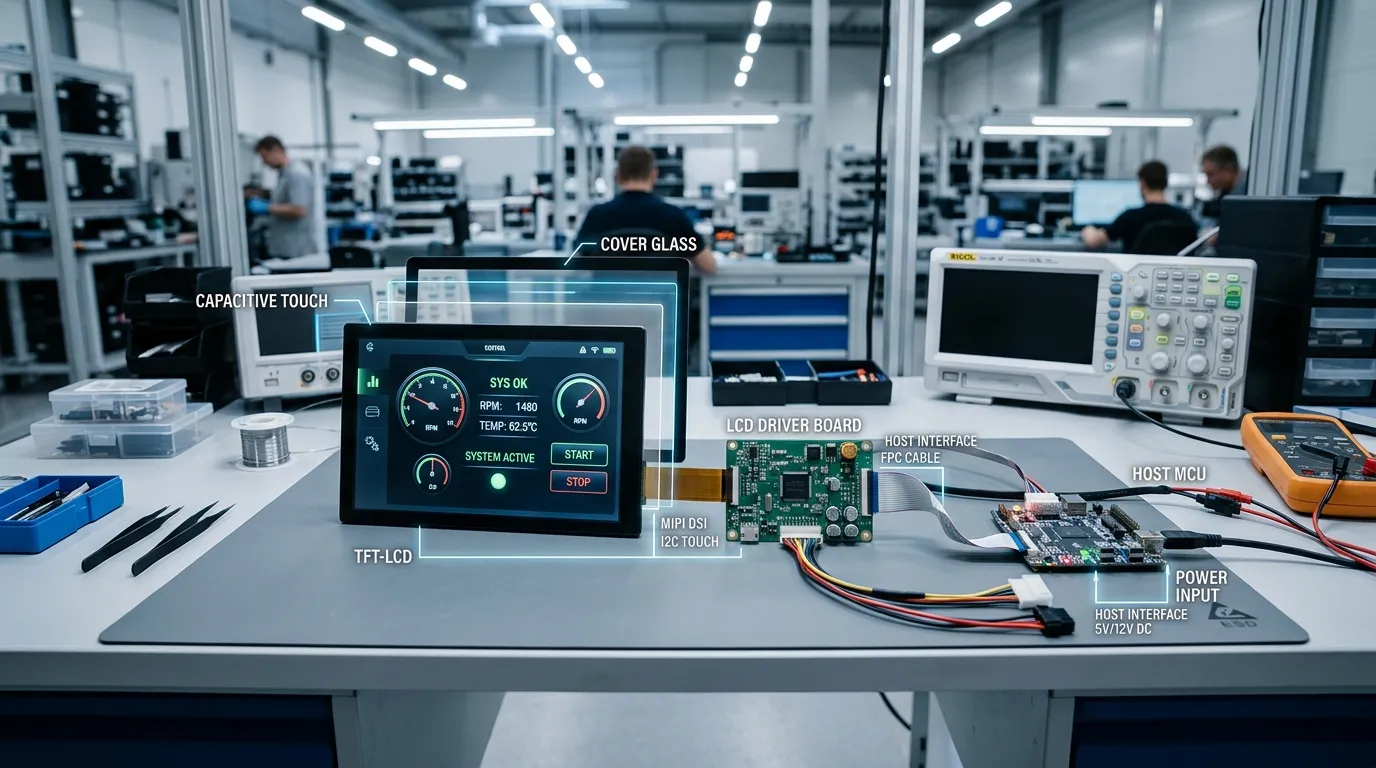
An embedded HMI requires more than a screen with the correct diagonal size. The panel must communicate with the host board, fit the enclosure, support the required touch method, and operate under the expected lighting and environmental conditions.
FaceLCD’s “LCD All in One Solution” positioning connects the main display components under one project workflow.
FaceLCD supplies TFT-LCD modules and other display technologies for embedded equipment. Panel selection can be based on:
The selected panel must also match the host system’s output and the physical limitations of the product housing.
FaceLCD can combine an LCD module with a projected capacitive or resistive touch panel, depending on how the equipment will be operated.
Capacitive touch is commonly selected for modern multi-touch interfaces and custom cover-glass designs. Resistive touch may be more suitable where pressure-based operation, gloves, or stylus input is required.
Project review can include:
Touch selection should be confirmed alongside the LCD and enclosure design rather than treated as a separate component at the end of development.
A driver board may be required when the host output does not directly match the LCD panel interface. FaceLCD can review the panel datasheet, resolution, timing, backlight, and available host signals before recommending a compatible board configuration.
Relevant inputs may include HDMI, VGA, DisplayPort, LVDS, MIPI DSI, RGB/TTL, eDP, or SPI, depending on the display and host platform.
The review may also cover:
| Solution Component | Main Variables to Confirm | What FaceLCD Reviews |
|---|---|---|
| LCD module | Size, resolution, brightness, interface, temperature | Application and host compatibility |
| Touch panel | Capacitive or resistive, controller, cover glass, FPC | Operation, dimensions, and alignment |
| Driver board | Host input, panel output, timing, power, backlight | Panel-to-board compatibility |
| Cables and FPC | Connector, pinout, length, exit direction | Routing and assembly requirements |
| Open-frame structure | Frame, mounting holes, board position, front opening | Fit inside the customer’s equipment |
Not every project needs the same level of integration. FaceLCD can review whether the customer needs an individual panel, a touch-display assembly, a matched board kit, or a more complete open-frame unit.
A bare LCD module may be suitable when the customer already has:
An LCD and touch assembly is suitable when the front interface must be coordinated as one unit. This can include the display, touch sensor, controller, cover glass, and related FPC requirements.
This format is often selected when the product needs customized cover-glass dimensions, printing, touch geometry, or cable direction.
A matched kit can simplify early testing when the customer’s host system uses HDMI or another signal that the LCD panel does not accept directly.
The kit may include:
An open-frame monitor is appropriate when the customer needs a more assembled screen unit for installation inside a kiosk, control cabinet, inspection system, or commercial terminal.
The project may require review of the metal frame, front opening, mounting holes, board position, touch panel, cable route, and enclosure depth.
| Project Situation | Recommended Starting Format |
|---|---|
| Mainboard already supports the panel interface | Bare LCD or LCD-plus-touch assembly |
| Host system provides HDMI or another external video output | LCD with matched driver board |
| Screen must mount inside a cabinet or kiosk | Open-frame monitor |
| Cover glass and touch geometry are product-specific | Custom LCD-plus-touch assembly |
| Interface and compatibility are not finalized | Full requirement review before selection |
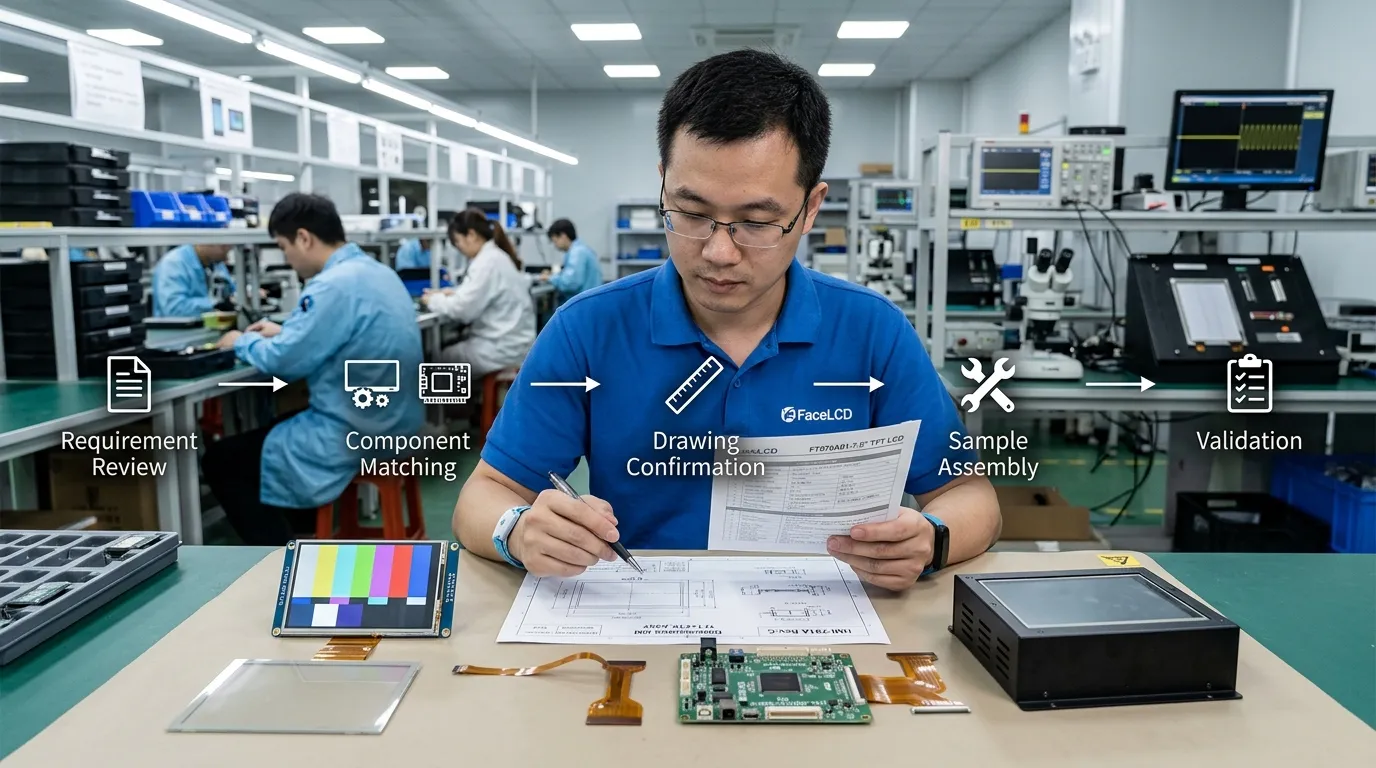
The process starts with the application and available technical information. Customers should provide as many of the following details as possible:
FaceLCD reviews whether an existing LCD module can meet the requirement and which supporting components are needed.
The review may identify:
The proposed configuration should clearly list the selected LCD, touch option, driver or converter board, cables, accessories, and any custom items.
If information is still missing, those points should be confirmed before the design moves to sampling.
Before sample production, the customer and FaceLCD should confirm:
This stage helps prevent the enclosure, board, and display assembly from being developed around conflicting dimensions.
The sample should be tested inside the actual or representative host system. Validation should cover:
After the sample is approved, the final specifications, drawings, components, quantities, and production requirements can be confirmed. Any change to the panel, touch construction, board, connector, or enclosure should be reviewed before repeat production.
Requirements → Component Review → Configuration Proposal → Drawing Approval → Sample → Validation → Production
A complete requirement allows FaceLCD to recommend a more suitable configuration and reduces unnecessary sample revisions.
Screen resolution, processor capability, touch interaction, brightness, and interface design also affect the final user experience. These factors are covered in more detail in FaceLCD’s guide to TFT LCD UI design considerations.
A standard embedded display configuration is usually the best starting point when an existing panel, touch option, and interface already meet the project requirements.
A custom solution may be needed when the equipment requires:
Not every panel parameter can be changed. In some cases, selecting a different standard LCD is more practical than modifying an existing model. FaceLCD should review whether the requirement involves standard component selection, assembly customization, or a fully custom component before providing a proposal.
Sourcing the LCD, touch panel, board, and cables from unrelated suppliers can create unclear responsibility when the completed assembly does not work as expected.
Coordinating the display stack through FaceLCD can provide:
This does not replace the customer’s complete system testing. The host board, enclosure, power design, software, EMI performance, and final application must still be validated as a complete product.
FaceLCD was founded in 2009 and operates factories in Shenzhen and Dongguan. Its product scope includes LCD modules, capacitive and resistive touch panels, LCD driver boards, open-frame monitors, and LCD all-in-one machines.
The company supports display products from small embedded modules to larger monitor formats and serves OEM and ODM customers across industrial control, medical equipment, security, smart home, automotive, commercial display, AI, and inspection-equipment markets.
For an embedded-display project, buyers should request relevant proof such as:
Specific lead times, customization limits, testing requirements, and production quantities should be confirmed for the selected configuration rather than assumed from a general product category.
To receive a practical recommendation, send FaceLCD:
FaceLCD can review and supply the display-side components required for the project, including the LCD module, touch panel, driver or converter board, cables, and open-frame structure where applicable. The exact scope depends on the host system and mechanical design.
Yes, subject to technical review. Send the exact panel model or datasheet, resolution, interface, connector, backlight specification, and required host input.
Yes. Customers can discuss individual LCD modules, touch panels, driver boards, or a more integrated configuration based on the project requirement.
Customization may include cover-glass dimensions, printing, shape, touch size, controller, FPC, and cable direction. Feasibility must be confirmed from the drawing and quantity requirements.
Send the panel datasheet, mechanical drawing, host-board specification, interface information, touch requirements, application details, and expected operating conditions.
FaceLCD can review requirements such as brightness, viewing angle, touch operation, operating temperature, and installation environment against the available display options. Environmental requirements should be declared before sample selection.
A sample can be used to validate image output, touch performance, mechanical fit, cable routing, host compatibility, and other application requirements before the production configuration is confirmed.
Send FaceLCD your display specification, host interface, drawing, touch requirements, sample quantity, and estimated production volume. FaceLCD will review the LCD, touch panel, driver board, cables, and installation requirements and propose a suitable standard or custom embedded display solution for quotation.