
FaceLCD Hong Kong Limited
Tel: +8615818692944
E-mail: sales@facelcd.com
Address: 13F, Buiding B, Colorful Tech Park, Guanlan High tech park, Longhua Dist, Shenzhen,China ZIP code 518100
You are here: Home > Technology >
Meta Description
Learn how in‑Cell screen technology differs from traditional TFT LCD. Discover benefits like thinner design, better display clarity, and improved touch integration for smartphones and industrial applications.
Introduction
People spend hours each day looking at smartphone screens.
When buying a phone, buyers often see terms like “In‑Cell screen” or “full lamination display.”
For most consumers, these words sound complex and technical.
Both In‑Cell and traditional TFT LCD share the same core technology.
That technology is TFT‑LCD, which stands for thin‑film transistor liquid crystal display.
Their real difference lies not in how they show images.
Instead, it lies in how they integrate touch functionality.
In simple terms, traditional TFT LCD is a broader concept.
In‑Cell technology represents a major evolution toward thinner screens.
To understand the difference, start with the classic “sandwich” structure of a display.
1. The Classic “Sandwich” Structure of a Display
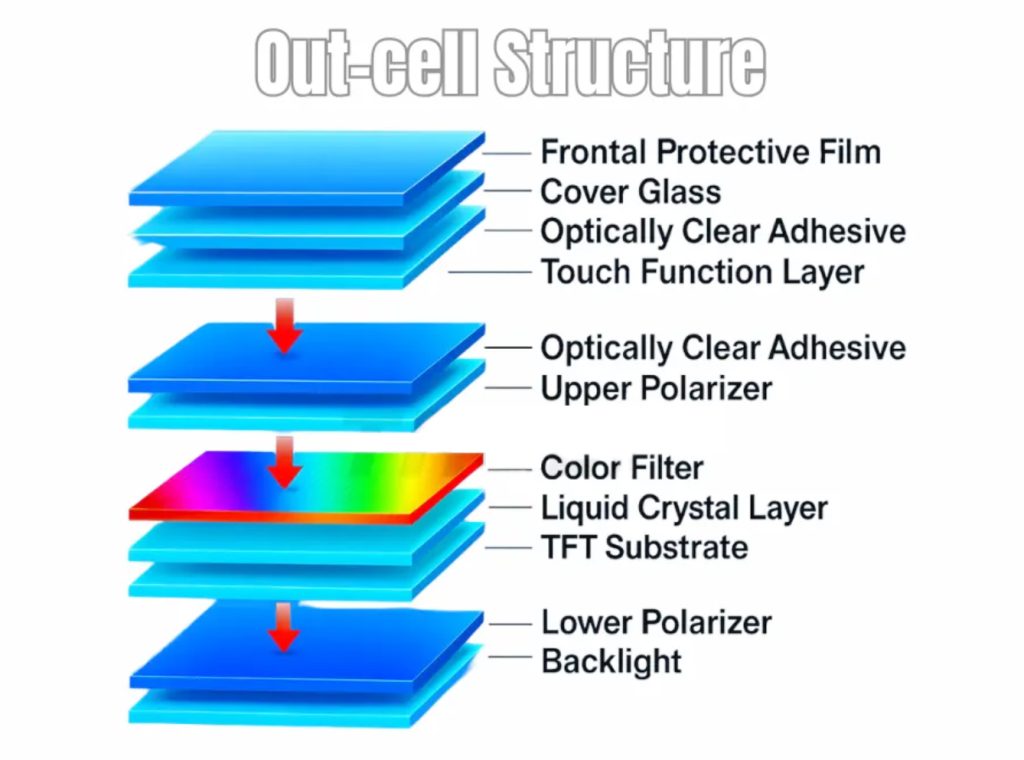
A traditional touchscreen display has three main layers:
In early designs, this setup was called “add‑on” or “external” touch.
Manufacturers built the touch layer separately from the display panel.
They then bonded both layers with the cover glass.
This process was relatively simple but had clear downsides.
The screen became thick and heavy.
Air gaps between layers caused light refraction.
As a result, image quality looked hazy and less vivid.
2. What Is a Traditional TFT LCD?
When people refer to a “traditional TFT LCD,” they usually mean two things.
First, it refers to screens using the external touch structure.
Second, it refers to LCDs without advanced embedded touch technology.
In this design, the touch layer exists as a separate physical component.
This adds thickness to the entire display module.
It also consumes valuable space inside the device.
Later, “full lamination” technology emerged to improve image quality.
One example is OGS, or one glass solution.
It uses optical adhesive to eliminate the air gap between layers.
However, the touch layer still remains an independent part.
Thus, this approach did not fundamentally simplify the screen structure.
3. In‑Cell Technology: Embedding Touch Into the Display
In‑Cell technology changed the design approach completely.
Its core idea is simple yet powerful.
Since touch is essential, why not embed it directly into the display panel?
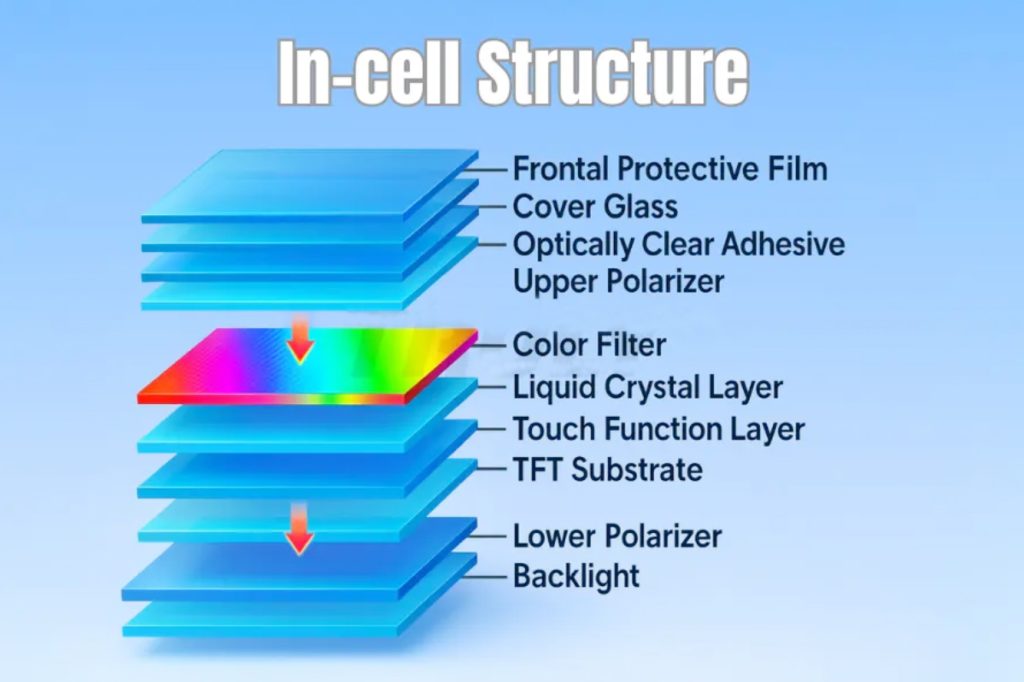
In‑Cell technology achieves exactly that.
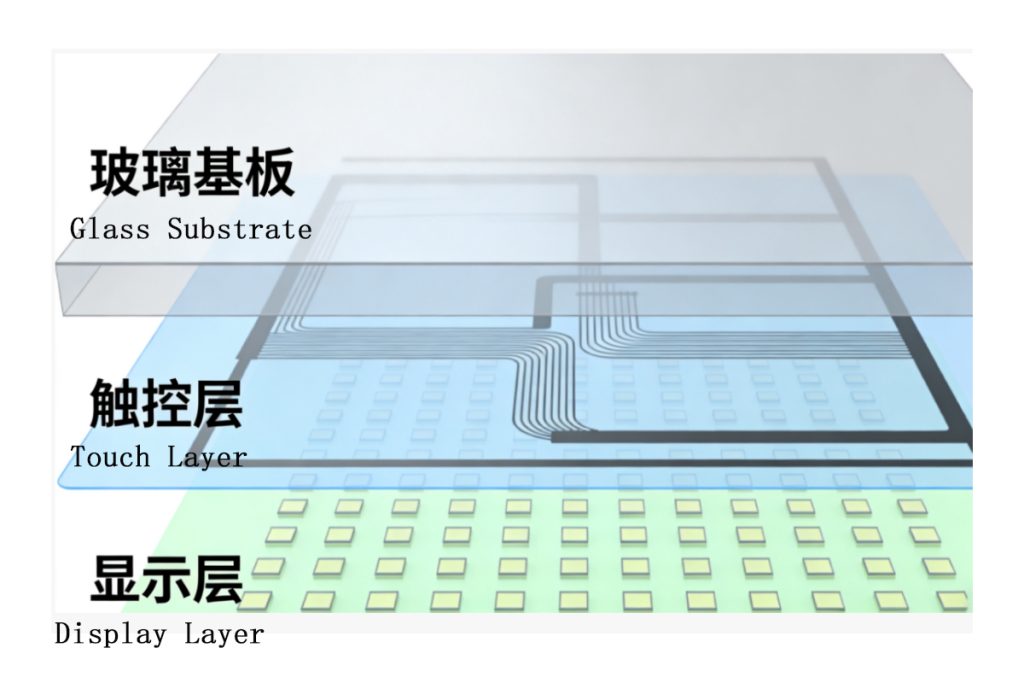
It integrates touch layer functions directly into the TFT LCD pixel array.
Imagine a neighbor moving from a separate house into your own home.
That is how In‑Cell brings touch and display together.
This highly integrated design offers several clear advantages:
4. Head‑to‑Head Comparison: Key Differences
To better understand the differences, examine them across several dimensions.
4.1 Structural Design
4.2 Thickness and Weight
4.3 Display Quality
4.4 Touch Sensitivity
4.5 Manufacturing Complexity and Cost
5. Key Applications of In‑Cell and TFT LCD Technologies
Both technologies serve a wide range of industries beyond smartphones.
5.1 Smartphones and Tablets
In‑Cell screens dominate mid‑range and premium mobile devices.
They enable slim form factors and crisp outdoor visibility.
5.2 Automotive Displays
Modern vehicles use TFT LCDs for instrument clusters and infotainment systems.
In‑Cell technology provides better touch responsiveness for center consoles.
5.3 Industrial and Medical Equipment
Traditional TFT LCDs remain popular for industrial control panels.
Their mature supply chain ensures reliability and long‑term availability.
Medical monitors often use high‑brightness TFT LCDs for diagnostic imaging.
5.4 Wearables and Smart Home Devices
Ultra‑thin In‑Cell screens benefit smartwatches and IoT interfaces.
The technology allows compact designs without compromising touch accuracy.
Conclusion
In‑Cell screens and traditional TFT LCDs share the same display foundation.
Their key difference lies in how they handle touch functionality.
Traditional TFT LCDs use a separate touch layer.
This design is reliable, cost‑effective, and widely available.
In‑Cell technology embeds touch directly into the display panel.
This delivers thinner devices, better image clarity, and improved space efficiency.
However, it requires higher manufacturing precision and advanced touch ICs.
Choosing between them depends on the application.
For premium consumer electronics, In‑Cell offers clear advantages.
For industrial or cost‑sensitive projects, traditional TFT LCD remains a strong choice.