
FaceLCD Hong Kong Limited
Tel: +8615818692944
E-mail: sales@facelcd.com
Address: 13F, Buiding B, Colorful Tech Park, Guanlan High tech park, Longhua Dist, Shenzhen,China ZIP code 518100
You are here: Home > Technology >
An LCD display with RGB interface is widely used in industrial control systems, medical devices, automotive electronics, and embedded equipment. With its direct parallel connection between the display controller and TFT LCD panel, RGB interface provides predictable timing control, fast data transmission, and flexible integration for embedded applications.
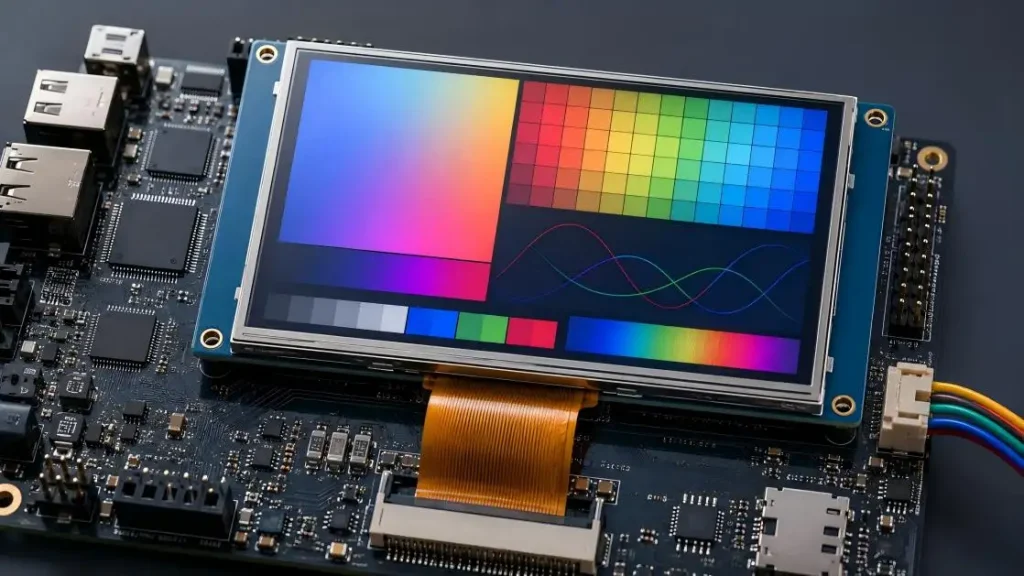
Among the key factors affecting display performance, the RGB color format determines color depth, memory consumption, interface bandwidth, and overall image quality. The proper format is selected depending on the needs of the LCD panel, capabilities of the host processor, and the requirements of the application environment.
This document will describe the various formats and the most recognized RGB formats found in TFT LCD modules, and how engineers can identify the proper format for industrial display applications.
An RGB interface LCD uses an individual red, green, and blue channel to receive color image data. A standard RGB interface includes:
•RGB data lines
•A pixel clock (PCLK)
•Horizontal and vertical sync (HS and VS)
•A data enable (DE) signal
During a pixel cycle, the LCD controller transmits the digital value for each of the color channels. The color depth and the possible range of colors are determined by the active bits assigned to each channel.
A common example is the usage of an RGB signal defined as RGB565 and the usage of an RGB signal defined as RGB888.
| Color Format | Bits Per Pixel | Maximum Colors | Typical Channel Configuration | Typical Applications |
| RGB565 | 16-bit | 65,536 | R5:G6:B5 | Embedded HMIs, Industrial Controllers, Portable Devices |
| RGB666 | 18-bit | 262,144 | R6:G6:B6 | Industrial Displays, Automotive Interfaces, Monitoring Systems |
| RGB888 | 24-bit | 16.7 million | R8:G8:B8 | Medical Displays, Inspection Systems, High Quality HMIs |
RGB565 is the most common format used in embedded TFT LCD applications.
It uses:
•5 bits for red
•6 bits for green
•5 bits for blue
Thus accommodating 65,536 possible colors at 16 bits (2 bytes) per pixel.
Benefits:
•Decreased frame buffer
•Decreased bandwidth
•Decreased cost and ease of access due to compatible microcontrollers
RGB565 is appropriate for equipment interfaces, control panels, handheld instruments, and simple graphic displays.
RGB565 is not suited for smooth gradients or photographs, as color banding will more than likely be visible.
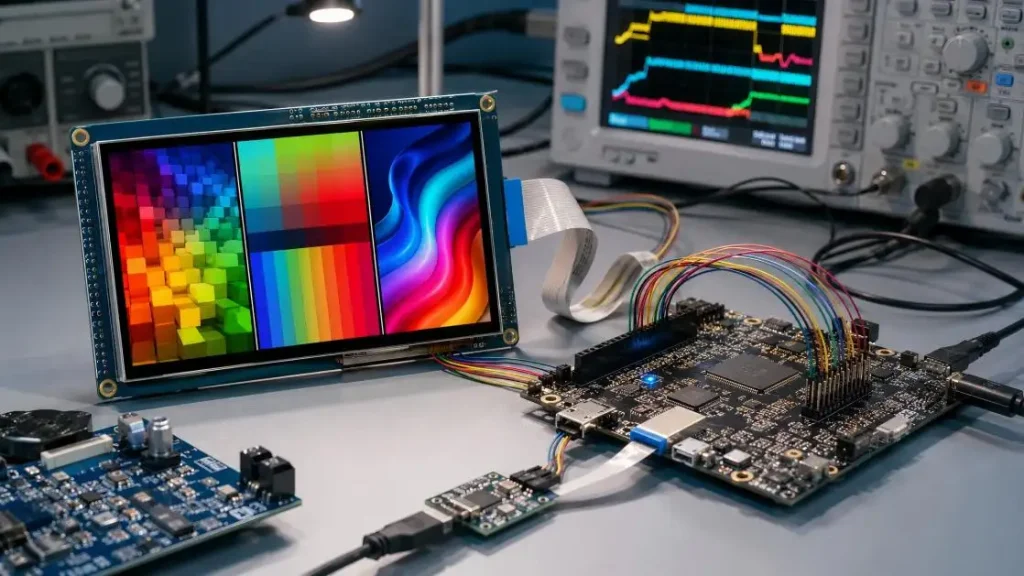
RGB666 is a compromise between system resources and color performance.
RGB666 allows for:
• 6 bits for red
• 6 bits for green
• 6 bits for blue
An improvement on RGB565, RGB666 is capable of producing 262,144 colors and even more delicate color gradations.
RGB666 is the preferred format for industrial TFT LCD panels.
It provides high enough visual quality for:
• Data displays
• Status indicators
• Dashboards
• Images
RGB666 still offers adequate embedded system color performance, but more color accuracy than RGB888 with even less data.
RGB888 describes the highest tier of RGB format applicable to TFT LCD modules.
With RGB888, every channel consists of:
• 8 bits of red
• 8 bits of green
• 8 bits of blue
Resulting in 16.7 million colors, allowing for color gradation and color representation of high fidelity.
RGB888 is commonly used in applications where representation of high fidelity images is critical, such as:
•Medical imaging systems
•Optical inspection systems
•Industrial Human Machine Interfaces (HMI)
•High Resolution Monitoring Terminals
RGB888 requires a substantial amount of bandwidth. A 24-bit RGB interface requires extensive line routing on the printed circuit board (PCB), high design and PCB fabrication costs, high-speed signal processing, and a well thought out PCB design to ensure signal integrity.
Choosing an RGB format is not as simple as choosing the format with the highest color depth. Engineers need to assess various system level considerations.
The selected RGB format must be supported by the display controller or processor. Very often, embedded systems work with RGB565 or RGB888. Any other formats will require considerable conversions, which may not be feasible.

The specification for the TFT LCD defines the supported RGB format, signal timing, and pin configuration. Mapping of RGB format can result in:
•Incorrect colors
•Diminished brightness perception
•Color banding
With the increase of color depth, there is an increase of:
•Frame buffer
•Data throughput
•Processing demand
For devices with limited resources or battery operated, RGB565 can be a good compromise.
The level of color precision is derived from the function of the product.
For example:
• Machine status panels most likely can function with RGB565 or RGB666. But RGB888 would be required for Medical imaging systems and Optical inspection systems.
Choosing the right RGB interface LCD goes beyond simply choosing the correct panel; it also involves ensuring dedicated engineering support during the integration process.
FaceLCD provides thorough product development assistance teamed with customizable industrial TFT LCD panels for control and display applications.
Some key aspects of our support include:
Each TFT LCD module is assessed for display performance, backlight uniformity, and optical quality to help ensure consistent and stable image quality.
Our engineering team is able to assess:
•RGB Bit Mapping
•Signal Timings
•FPC Connector Pin Assignments
•Host Controller
We offer various options depending on your needs including:
•FPC Connectors
•Positioning of Connectors
•Backlight Design
•Mechanical Integration
•And more.
For instance, our engineering team offers small RGB interface TFT LCD modules with a 3.5 inch 320 x 240 display, which can be utilized in portable equipment, testing devices, and embedded control devices which all require efficient performance of color displays.
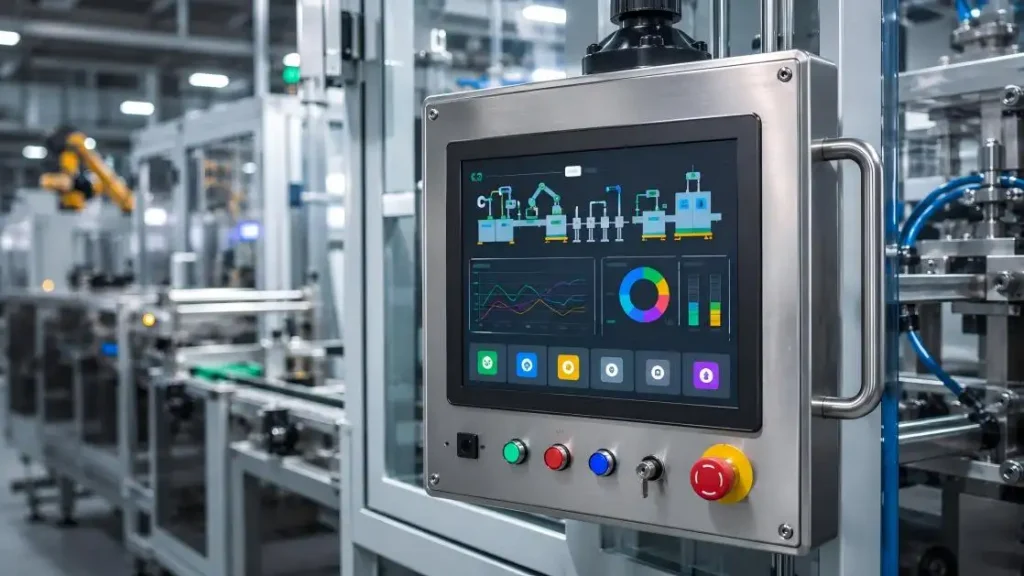
In order to achieve stable color performance, our engineers have found that it is critical to focus on RGB Register Setup, Signal Line Design, and Backlight.
The display controller output format must be configured to match the input requirements of the LCD panel. If this is not done, color distortion may occur.
For higher bit interfaces like RGB888, the routing of the signal on the PCB must be done with a high degree of care to ensure uniformity.
While the backlight does not impact the RGB color depth, uniformity and optical performance of the backlight do impact the perceived quality of the image.
The RGB565, RGB666, and RGB888 formats represent a move toward a greater depth of colors, and greater flexibility in memory and interface. Understanding these will greatly assist your engineers in the selection process.
FaceLCD offers TFT LCD display solutions for industrial projects featuring an RGB interface. We provide format verification and allow for customization. We assist with engineering from initial prototypes to large scale production. Get in touch with FaceLCD to select your desired RGB configuration, and to create a custom display solution.
Q1. What RGB format is ideal for embedded systems?
RGB565 is ideal for embedded systems since it consumes less memory and reduces data bandwidth.
Q2. What is the RGB565 and RGB888 differentiation?
With RGB565 and RGB888, the first is 16 bits with 65,536 colors, whereas the latter is 24 bits with 16.7 million colors with a greater potential for color accuracy.
Q3. What RGB format is typical for industrial TFT LCD panels?
The common RGB formats for industrial TFT LCD are RGB565 and RGB888 based on the availability of system resources and the required image and color quality.
Q4. If RGB888 is connected, can an RGB565 controller work with it?
An RGB565 controller can work with an RGB888 as long as the system is properly set up. However, the RGB888 will be in RGB565 mode and will, therefore, have a restricted color depth.
Q5. Does high RGB bit depth guarantee high quality displays?
High RGB bit depth does not guarantee high quality displays since quality displays are a function of the bit depth, resolution, display technology, the backlight, and the design.