
FaceLCD Hong Kong Limited
Tel: +8615818692944
E-mail: sales@facelcd.com
Address: 13F, Buiding B, Colorful Tech Park, Guanlan High tech park, Longhua Dist, Shenzhen,China ZIP code 518100
You are here: Home > Technology >
Modern display systems do not necessarily rely on a screen. Every transparent picture possesses a smart control system, interpreting the signals, controlling the power, and providing comfortable usage. Here, an LCD HDMI Driver Board is required.
An LCD HDMI driver board is an electronic control board that converts HDMI signals to a format that can be read by an LCD panel. It is the medium of communication between the display and the video source. The majority of LCDs lack the circuitry to decode the video signals received by them, and thus cannot display an image without an LCD controller board. An average HDMI controller board carries out a number of important functions:
• HDMI signal conversion
• Video signal processing
• Resolution scaling
• Backlight control
• Power management
• OSD menu control
• Display timing management
Consider it the brain behind the screen. It takes the input of devices like PCs, media players, industrial controllers, Raspberry Pi systems, and embedded platforms and converts it to a format that can be displayed.
Knowing the operation of an HDMI display driver board will enable users to choose the appropriate solution for their project.
The procedure usually involves the following steps:
1. Video information is fed into the HDMI input.
2. The signal is processed by a display controller IC.
3. The display scaler IC adjusts resolution and timing.
4. Image output is synchronized by the display timing controller.
5. The LCD interface board transforms the signals to LVDS, eDP, TTL, or MIPI.
6. The backlight driver circuit provides the power to the panel illumination.
7. The last picture is displayed on the screen.
This series provides a smooth picture display, correct color display, and fixed display refresh rates.
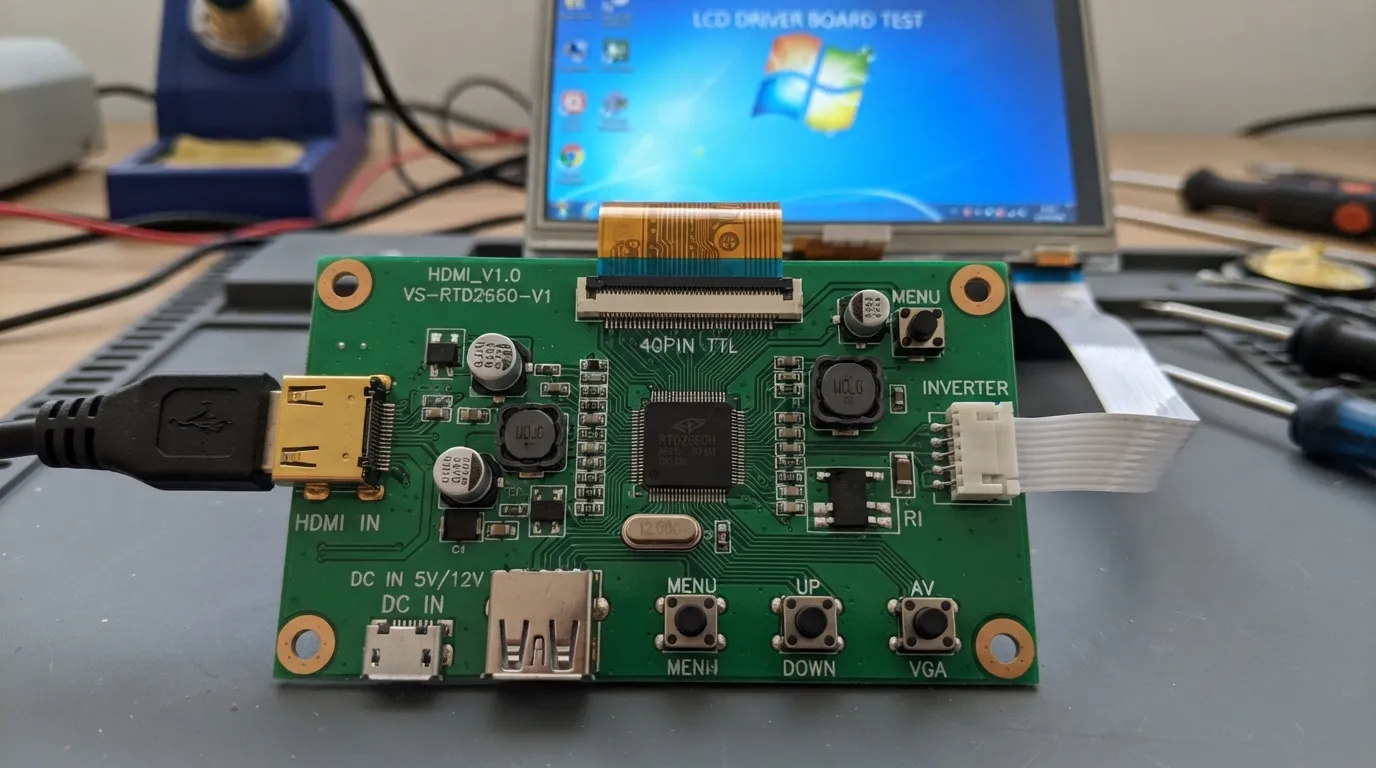
There is a Problem with the LCD Panel Compatibility
Proper compatibility is one of the most significant aspects to be considered when choosing an LCD panel controller board.
Key factors include:
• Resolution matching
• Signal interface type
• Backlight voltage
• Connector orientation
• Power requirements
• Refresh rate compatibility
The result of a discrepancy may be:
• No image output
• Flickering displays
• Incorrect colors
• Panel damage
That is why FaceLCD suggests checking the specifications of panels prior to selecting an HDMI LCD controller.
The flexibility of the contemporary display driver boards enables them to be applicable in many industries.
An LCD controller board is an industrial LCD controller board is used in:
• Factory control systems
• Automation equipment
• Machine interface displays
• HMI display controller boards
The industrial environment requires stable signal transmission and stability.
Special LCD controller board for digital signage displays enables:
• Retail advertising
• Information kiosks
• Transportation displays
• Interactive public screens
Medical displays are likely to be dependent on:
• High-resolution imaging
• Stable refresh rates
• Consistent color accuracy
This renders dependable medical display controllers necessary.
The display controller board is attached to a board that supports:
• IoT devices
• Smart appliances
• Monitoring systems
• Portable electronics
The majority of the existing POS terminals accept:
• TFT display controller boards
• Touch controller integration
• HDMI display boards
LCD HDMI driver board can be a DIY developer board in Raspberry Pi applications. Popular uses include:
• Home automation dashboards
• Digital photo frames
• Portable monitors
• Smart control panels
Similarly, HDMI controller boards are often employed in projects with Arduino where a complex graphical interface is required. These projects have the advantage of:
• Easy HDMI connectivity
• Big LCD panel support.
• Support for flexible display resolution.
The explanation as to why Multi-Input Driver Boards are gaining popularity. Today, the displays in use are more flexible than ever.
Combinations such as the FaceLCD MS25C combine:
• HDMI
• Type-C
• VGA
• Audio input
• LVDS output
The architecture allows developers and manufacturers to support new and older devices with a single LCD video controller board.
FaceLCD provides solutions to TFT LCD modules, embedded systems, digital signage, and custom display applications as industrial LCD controller solutions, HDMI controller board solutions, and LCD monitor driver board solutions. If you need LVDS, eDP, MIPI DSI, or TTL display support, the FaceLCD team can help you to select the right board, cable, voltage setup, and display interface to provide the best performance. Stop by FaceLCD and convert your LCD into a complete display solution.