
FaceLCD Hong Kong Limited
Tel: +8615818692944
E-mail: sales@facelcd.com
Address: 13F, Buiding B, Colorful Tech Park, Guanlan High tech park, Longhua Dist, Shenzhen,China ZIP code 518100
You are here: Home > Technology >
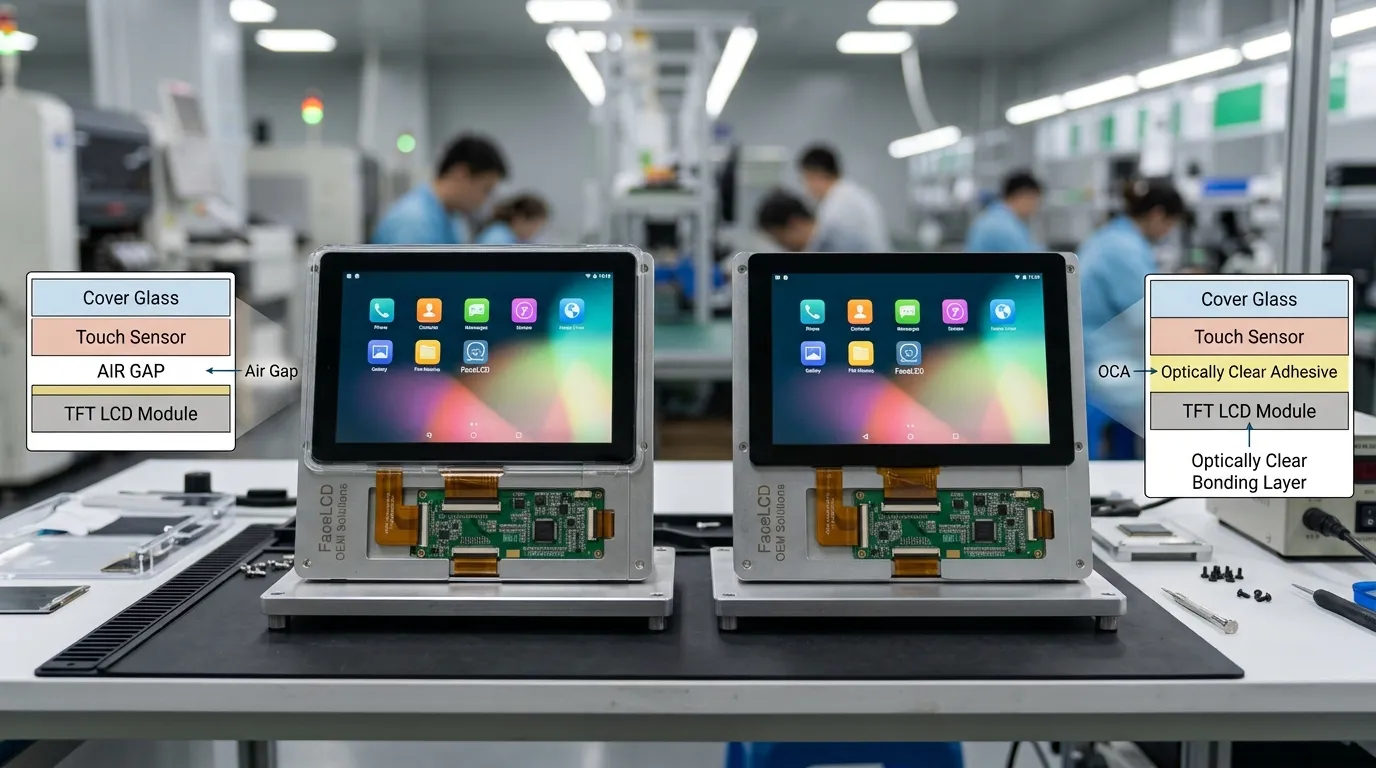
When comparing optical bonding vs air bonding, the main difference is what sits between the LCD and the touch panel or cover glass. Air bonding attaches the layers around the perimeter and leaves an air gap. Optical bonding fills that space with an optically clear adhesive.
Optical bonding usually provides better visibility, lower internal reflection, reduced parallax, and stronger resistance to dust or condensation. Air bonding is generally simpler, more economical, and easier to repair.
Neither method is automatically right for every product. The correct choice depends on lighting, operating environment, mechanical stress, service requirements, housing design, and project cost.
| Comparison Area | Air Bonding | Optical Bonding |
|---|---|---|
| Assembly structure | Layers attached around the perimeter | Transparent adhesive applied across the display area |
| Air gap | Remains between the LCD and touch panel | Air gap is removed |
| Internal reflection | Higher because light passes through air interfaces | Lower because the bonding material reduces internal reflection |
| Outdoor readability | Suitable only when standard visibility is acceptable | Usually better under strong ambient light |
| Parallax | More noticeable because of the distance between layers | Reduced because the layers are closer together |
| Dust and condensation | Air gap can create space for contamination or moisture | Less internal space for dust or condensation |
| Shock and vibration | Depends heavily on frame and housing support | Bonded layers act more like one assembly |
| Product thickness | Requires space for the gap and frame adhesive | Can create a more integrated display stack |
| Manufacturing complexity | Lower | Higher |
| Relative cost | Usually lower | Usually higher |
| Repairability | Individual parts are generally easier to separate | Separation and rework are more difficult |
| Common applications | Indoor terminals, standard HMIs, and cost-sensitive equipment | Outdoor, marine, vehicle, industrial, and high-clarity displays |
A touch display may include cover glass, a capacitive or resistive touch sensor, adhesive material, and a TFT LCD module. The bonding method determines how these layers are physically joined.
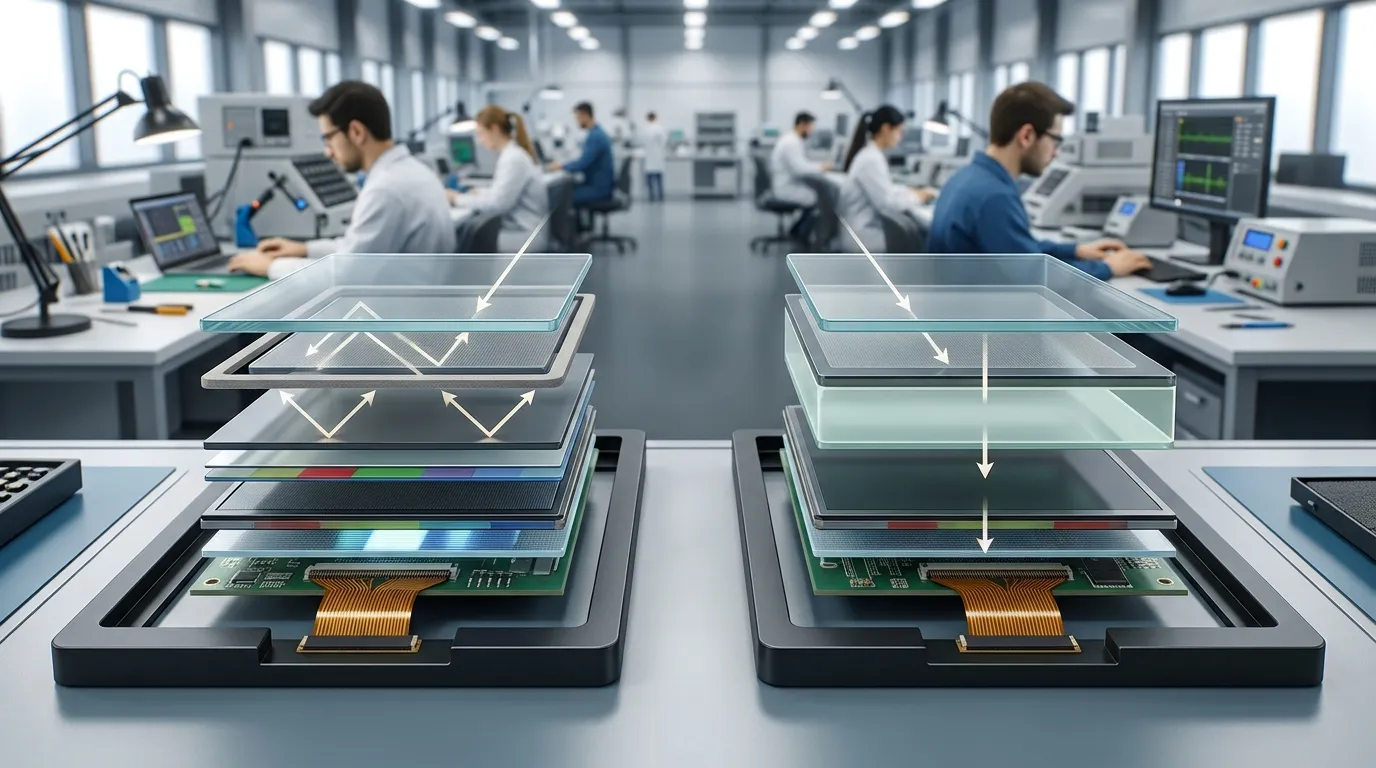
Air bonding is also called frame bonding or perimeter bonding. Adhesive tape or another bonding material is placed around the outer area of the LCD or touch panel. The two components are aligned and attached, but the central display area is not filled with adhesive.
This structure leaves a thin air gap between the LCD and the touch layer.
Air bonding offers several practical advantages:
However, the air gap creates additional optical interfaces. Light can reflect between the glass, air, touch sensor, and LCD surfaces. The gap may also make the displayed image appear farther below the touch surface.
Optical bonding, sometimes called full lamination, fills the area between the display layers with an optically clear material. Depending on the product structure and process, this may involve solid optically clear adhesive, known as OCA, or a liquid material such as OCR or LOCA.
The process generally includes:
The correct process depends on the LCD structure, touch technology, glass dimensions, adhesive format, and required production volume. Optical bonding therefore requires more process control than perimeter attachment.
An air-bonded display contains material-to-air interfaces. When light reaches these interfaces, part of it can reflect back toward the viewer. Under strong lighting, those reflections may reduce perceived contrast and make the display harder to read.
Optical bonding replaces the air gap with a transparent material selected to work with the surrounding display layers. This reduces internal reflection and can make black areas appear darker and displayed content easier to distinguish.
The improvement depends on the complete optical stack. LCD brightness, polarizer design, cover-glass thickness, anti-glare treatment, and anti-reflective treatment also influence readability. Optical bonding should not be treated as a replacement for all other optical design decisions.
For a standard indoor terminal, an air-bonded display may provide sufficient visibility. The environment usually has controlled lighting, limited glare, and predictable viewing angles.
Outdoor kiosks, marine equipment, vehicle displays, and exposed industrial controls face stronger ambient light. In these applications, reflections from an air gap can become more noticeable. Optical bonding can help preserve contrast by reducing the number of reflective interfaces inside the assembly.
However, an optically bonded low-brightness LCD may still perform poorly outdoors. The LCD backlight and cover-glass surface treatment must be evaluated together with the bonding method.
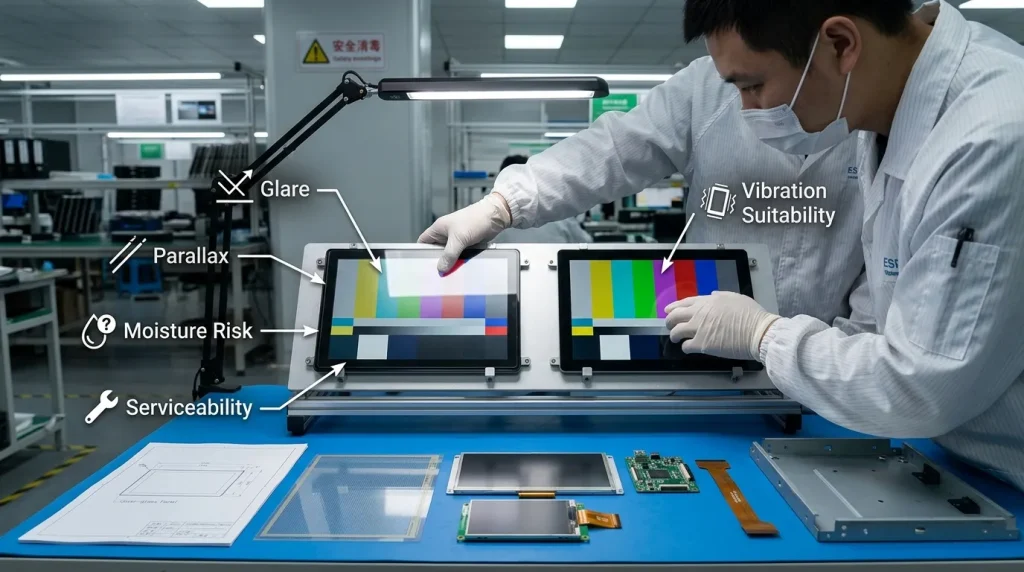
Parallax occurs when the displayed image appears visually separated from the surface being touched. It becomes more noticeable when there is a greater distance between the cover glass and the LCD image.
Because air bonding retains a gap, the image may appear deeper inside the product. This can affect perceived touch alignment, especially when the display is viewed from an angle.
Optical bonding reduces this distance. The touch surface and displayed content appear more closely integrated, which can improve the user’s perception of touch position. The bonding process does not replace touch-controller calibration, but it can reduce the visual separation that contributes to parallax.
Bonding affects durability, but it is only one part of the complete mechanical design.
In an air-bonded assembly, the perimeter adhesive and housing support the layers while the central area remains separated. If the frame structure is suitable, this can work well for indoor devices with limited impact, humidity, and temperature variation.
The retained gap can create additional concerns in demanding environments:
Optical bonding removes the open internal space and joins the display layers across a larger area. This can create a more unified assembly and improve resistance to shock, vibration, dust, and internal condensation.
These benefits make optical bonding a strong candidate for marine displays, outdoor equipment, transportation systems, industrial HMIs, and handheld inspection devices.
Bonding alone does not make a display waterproof. Front sealing, gaskets, enclosure design, connector protection, housing joints, and assembly tolerances still determine the final ingress-protection performance.
Air bonding normally requires fewer process steps and less specialized material. The adhesive is applied around the perimeter rather than across the complete visible area.
The method can reduce:
For cost-sensitive indoor products, these advantages can outweigh the optical benefits of full lamination.
Optical bonding places adhesive directly across the display area. Dust, bubbles, uneven adhesive, alignment errors, or pressure-related defects can remain visible after assembly.
The factory must control:
If a bonded assembly fails inspection, separating the parts may be difficult. In some cases, the LCD, touch panel, or cover glass may not be reusable. This increases material and production risk.
Air-bonded assemblies are generally easier to service because the perimeter adhesive can be removed and individual components may be replaced.
Optically bonded assemblies are more difficult to separate. Rework may require specialist equipment, and there is a higher risk of damaging the LCD, touch sensor, or glass.
For equipment designed around field replacement, repairability may support air bonding. For sealed products where optical quality and environmental resistance are more important than component-level repair, optical bonding may be the stronger option.
| Application | Likely Starting Choice | Decision Logic |
|---|---|---|
| Indoor control panel | Air bonding or optical bonding | Lighting, cleaning, impact, and budget determine the final choice |
| Factory HMI | Project-dependent | Optical bonding may help where glare, vibration, or contamination is significant |
| Outdoor kiosk | Optical bonding | Strong ambient light and environmental exposure increase the value of full lamination |
| Marine display | Optical bonding | Humidity, condensation, glare, salt exposure, and vibration are major concerns |
| Vehicle display | Optical bonding often preferred | Temperature changes, vibration, impact, and viewing conditions require stronger integration |
| Medical equipment | Project-dependent | Visibility, cleaning, reliability, servicing, and validation requirements must be balanced |
| Embedded self-service monitor | Either method | Installation environment, cost, and repair strategy are the main factors |
| Cost-sensitive indoor terminal | Air bonding | Controlled lighting and easier servicing may matter more than maximum optical performance |
| Handheld inspection device | Project-dependent | Impact resistance, clarity, weight, housing design, and repairability must be reviewed together |
These are starting recommendations, not fixed rules. An indoor industrial product may still require optical bonding if it operates under strong lighting or repeated vibration. An outdoor product may require more than bonding alone, including a high-brightness LCD, suitable surface treatment, front sealing, and a weather-resistant enclosure.
Related application decisions can also be explored through FaceLCD’s planned resources on outdoor capacitive touch screens, embedded touch screen monitors, marine touch screen displays, and G+G capacitive touch-screen structures.
Use the following questions before choosing a bonding method.
Optical bonding is usually the stronger candidate when readability, environmental resistance, vibration, or visual integration is critical.
Air bonding is usually the stronger candidate when the product operates indoors, standard optical performance is acceptable, cost is tightly controlled, and easier servicing is required.
FaceLCD manufactures LCD modules, capacitive and resistive touch panels, cover-glass assemblies, driver boards, monitors, and all-in-one display products. This allows the bonding decision to be reviewed as part of the complete display system rather than as an isolated component purchase.
Before sampling, the engineering team may need to review:
Alignment must be checked across the LCD, touch sensor, cover glass, and final enclosure. A bonding decision made before the housing is finalized can reduce mechanical conflicts later.
FaceLCD can evaluate air bonding and optical bonding based on:
The recommendation should reflect the actual product environment. Optical bonding should not be selected only because it is viewed as a premium method, and air bonding should not be selected only because its initial assembly cost is lower.
Sample inspection may include:
FaceLCD operates manufacturing facilities in Shenzhen and Dongguan and has a fully laminating dust-free workshop. Exact bonding dimensions, adhesive options, testing requirements, and inspection tolerances should be confirmed for each project.
Provide the following information when requesting an assembly review:
No. Optical bonding usually performs better for clarity, parallax, contamination resistance, and harsh environments. Air bonding may be more suitable for controlled indoor products where lower cost and easier repair are more important.
Optical bonding is normally the stronger starting choice because it reduces internal reflection and removes the air gap. Outdoor readability also depends on LCD brightness, cover-glass treatment, enclosure design, and viewing conditions.
Yes. Air bonding can work well for indoor industrial equipment with controlled lighting, limited moisture, and moderate mechanical stress. The final choice depends on the installation environment and service requirements.
It can improve perceived touch alignment by reducing parallax between the touch surface and the displayed image. Actual electrical touch accuracy still depends on the touch sensor, controller, firmware, and calibration.
Repair is possible in some cases, but separating the layers is more difficult than with air bonding. Rework may require specialist equipment and may damage the LCD, touch panel, or cover glass.
No. Optical bonding can reduce internal space for moisture, but waterproof performance depends on the complete enclosure, gaskets, front seal, connectors, housing joints, and assembly tolerances.
Send the LCD model, touch specification, cover-glass drawing, housing dimensions, operating environment, lighting conditions, temperature and humidity requirements, mechanical requirements, service expectations, sample quantity, and expected production volume.
Send FaceLCD your display specification, touch-panel requirements, cover-glass drawing, housing dimensions, operating environment, and project quantity. The engineering team can review whether air bonding or optical bonding provides the right balance of clarity, durability, cost, and serviceability before sample production.