
FaceLCD Hong Kong Limited
Tel: +8615818692944
E-mail: sales@facelcd.com
Address: 13F, Buiding B, Colorful Tech Park, Guanlan High tech park, Longhua Dist, Shenzhen,China ZIP code 518100
You are here: Home > Technology >
FaceLCD supplies small-size TFT-LCD modules beginning at 0.96 inch for compact IoT devices, handheld equipment, smart controls, meters, portable instruments, and other embedded products. Both touch and non-touch configurations are available, with project support covering interface selection, FPC design, connector position, cover glass, backlight, bonding, and sample validation.
Send your target display size, resolution, interface, touch requirement, mechanical drawing, and estimated order quantity to FaceLCD for model matching and a project quotation.
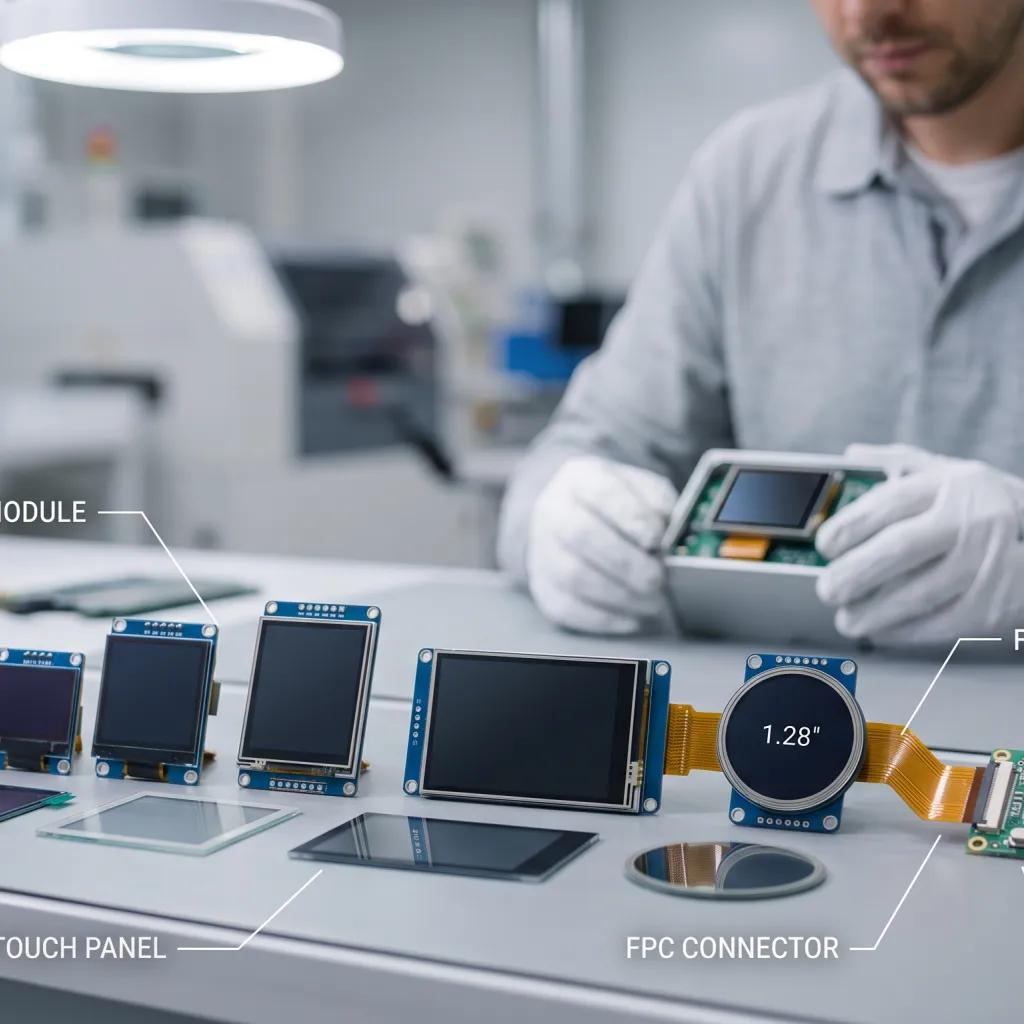
FaceLCD’s small-display product line is designed for devices where enclosure space, power consumption, interface compatibility, and information density must be carefully balanced. The available portfolio begins at 0.96 inch and includes standard and project-specific configurations for embedded product development.
Depending on the selected model and project requirements, available configurations may include:
Not every option is available for every display model. FaceLCD reviews the required dimensions, electrical parameters, interface, touch structure, and production quantity before confirming the final configuration.
| Selection Factor | Possible FaceLCD Options | Information Required from the Buyer |
|---|---|---|
| Display size | Small TFT-LCD models beginning at 0.96 inch | Housing opening, outer dimensions, and active-area requirement |
| Resolution | Model-specific resolution options | UI content, graphics, and readability requirements |
| Interface | SPI, MCU, RGB, MIPI, or another supported interface | Host processor and available display connection |
| Display structure | IPS or TN where available | Viewing direction and image-quality requirement |
| Touch | Capacitive, resistive, or non-touch | Input method and operating environment |
| Backlight | Standard or customized options where supported | Brightness, power, and viewing conditions |
| FPC and connector | Standard or project-specific design | PCB position, pinout, routing, and available space |
| Cover glass | Customized outline and printing where supported | Front-panel drawing and appearance requirements |
| Bonding | Air bonding or optical bonding where supported | Clarity, durability, thickness, and front-structure requirements |
Compact devices do not all require the same input method. FaceLCD can help buyers evaluate whether the product should use a non-touch display, capacitive touch, or resistive touch based on the device controls, housing, operating environment, and user interaction.
A non-touch LCD may be suitable when the device uses physical buttons, a keypad, a rotary control, or an external input system. This configuration can reduce the complexity of the front assembly when touch input is unnecessary.
Capacitive touch may be appropriate for finger-controlled compact devices with a glass front panel. Depending on the selected display and touch solution, the project may require confirmation of the touch controller, cover-glass dimensions, interface, bonding method, and environmental requirements.
Resistive touch can be considered for products that require pressure-based input, stylus operation, or certain glove-use conditions. Availability and mechanical compatibility must be confirmed for the selected small LCD module.
| Configuration | Typical Product Fit | Key Requirement to Confirm |
|---|---|---|
| Non-touch | Status display, button-controlled device, or rotary-control product | External control method and front-panel design |
| Capacitive touch | Finger-controlled compact device with a glass front | Cover glass, touch controller, interface, and operating conditions |
| Resistive touch | Pressure, glove, or stylus-controlled equipment | Model availability, overlay fit, and durability requirements |
More information about available touch structures can be found on the capacitive and resistive touch panel category page.
Selecting a display based only on diagonal size can lead to enclosure, PCB, interface, or power problems during prototyping. FaceLCD reviews both mechanical and electrical requirements before recommending a standard model or customized configuration.
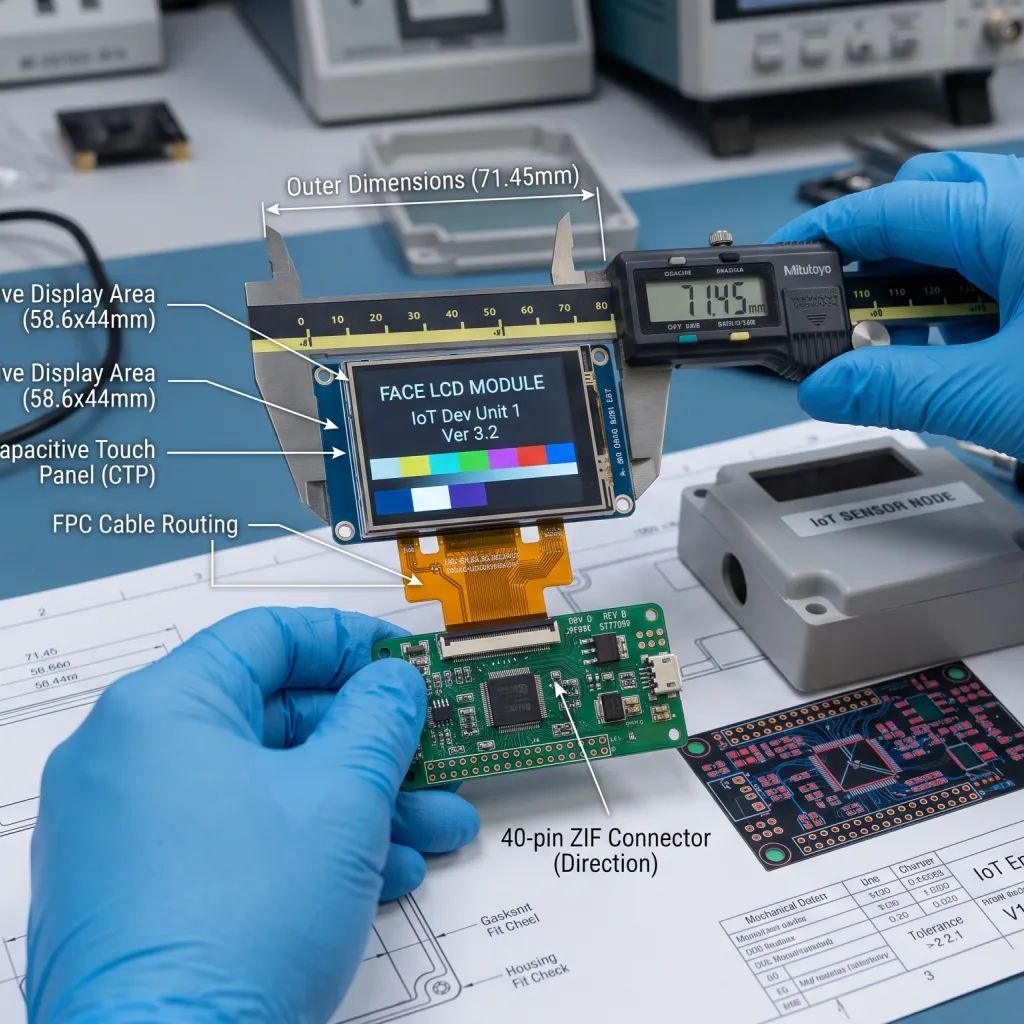
The mechanical review should consider:
The electrical review should confirm:
The selected module should also match the product’s viewing and operating conditions. Buyers should specify requirements such as viewing angle, orientation, brightness, indoor or bright-light use, operating temperature, touch conditions, and power limitations.
Typical compact applications may include:
The final display choice depends on the product’s actual mechanical, electrical, visual, and environmental requirements.
FaceLCD can support standard module sourcing as well as projects that require changes to related display components. The exact customization scope depends on the selected model, required quantity, tooling requirements, and technical feasibility.
Depending on the project, FaceLCD may also support driver-board matching, cables, display-and-touch assembly, sample documentation, and mechanical or electrical drawings.
Buyers requiring a wider custom solution can review FaceLCD’s TFT-LCD display modules and submit the relevant specifications for engineering review.
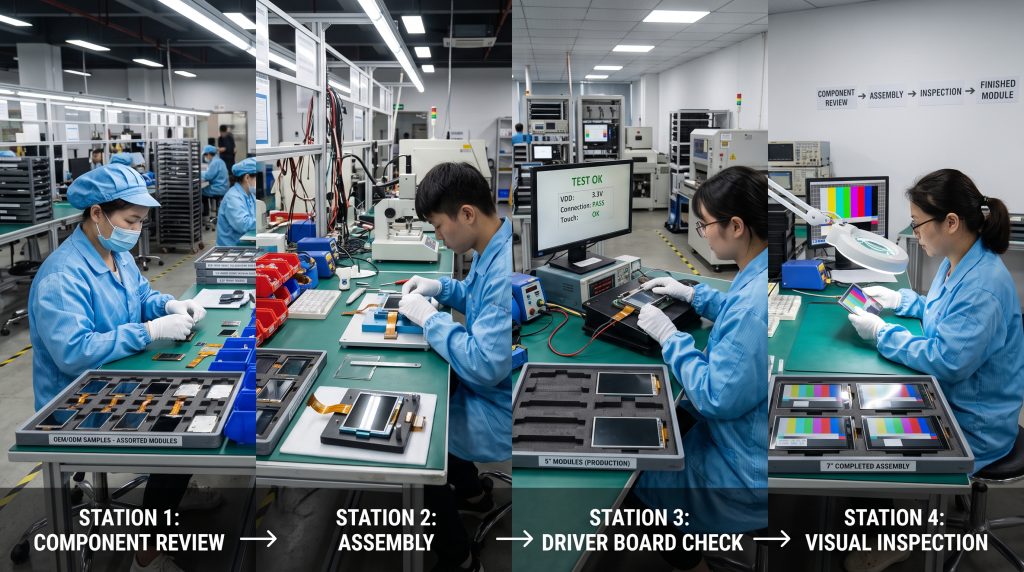
FaceLCD was founded in 2009 and states that it operates factories in Shenzhen and Dongguan. Its wider product portfolio includes TFT-LCD modules, touch panels, driver boards, monitors, and integrated LCD products, with display sizes beginning at 0.96 inch.
For small-display projects, FaceLCD can support buyers with:
FaceLCD also states that it exports products to more than 40 countries. Buyers can review additional company information on the FaceLCD manufacturing capabilities page.
Providing complete project information allows FaceLCD to recommend a more suitable model and prepare a more accurate quotation.
| RFQ Information | Why It Is Needed |
|---|---|
| Mechanical drawing | Confirms housing fit, active area, thickness, mounting, and FPC space |
| Interface and host board | Helps prevent signal, controller, and connector mismatch |
| Touch requirement | Determines the touch structure, controller, cover glass, and bonding needs |
| Brightness and environment | Supports display-structure and backlight evaluation |
| Quantity and schedule | Separates sample, trial-production, and repeat-order planning |
| Existing model number | Helps identify a replacement or compatible alternative |
FaceLCD’s published display range begins at 0.96 inch. Availability, resolution, interface, viewing direction, and production status should be confirmed for the specific model before an order is placed.
The confirmed lower boundary is 0.96 inch. Buyers should provide their required outer dimensions and active area so FaceLCD can recommend a suitable model within the current small-display range.
Yes. FaceLCD supports non-touch displays and can match selected modules with capacitive or resistive touch solutions where technically available.
FPC length, routing direction, connector position, and pin arrangement may be customized depending on the selected module, project quantity, and engineering feasibility.
FaceLCD’s wider TFT-LCD portfolio includes SPI, MCU, RGB, MIPI, and other interfaces. The available interface depends on the selected display model and the buyer’s host board.
FaceLCD can support touch-panel matching, customized cover glass, border printing, touch FPC, controller requirements, and bonding where supported by the selected display configuration.
Yes. Samples can be prepared for mechanical, electrical, display, touch, power, and system-level validation before trial or production planning.
Useful files include mechanical drawings, enclosure dimensions, PCB drawings, interface details, pinout requirements, cover-glass drawings, an existing display datasheet, and estimated order quantities.
Buyers can submit the existing model number, datasheet, dimensions, interface, connector, and pinout. FaceLCD can then review whether a standard or customized alternative is available.
Discuss expected annual quantity, project duration, production schedule, and continuity requirements before approval. Product availability should be confirmed for the exact selected model rather than assumed from a general category listing.
To request a model recommendation, datasheet, sample, or quotation, send FaceLCD your target size, mechanical drawing, resolution, interface, host-board details, touch requirement, operating environment, sample quantity, and estimated production volume.
Request a small LCD display quote and ask FaceLCD to review your compact IoT device requirements.