
FaceLCD Hong Kong Limited
Tel: +8615818692944
E-mail: sales@facelcd.com
Address: 13F, Buiding B, Colorful Tech Park, Guanlan High tech park, Longhua Dist, Shenzhen,China ZIP code 518100
You are here: Home > Technology >
A standard TFT LCD may perform well indoors but become difficult to read under direct sunlight. Strong ambient light reflects from the cover glass, touch panel, polarizer, and internal air gaps, washing out text and graphics. Increasing backlight brightness can help, but it also raises power consumption, LED junction temperature, and enclosure heat.
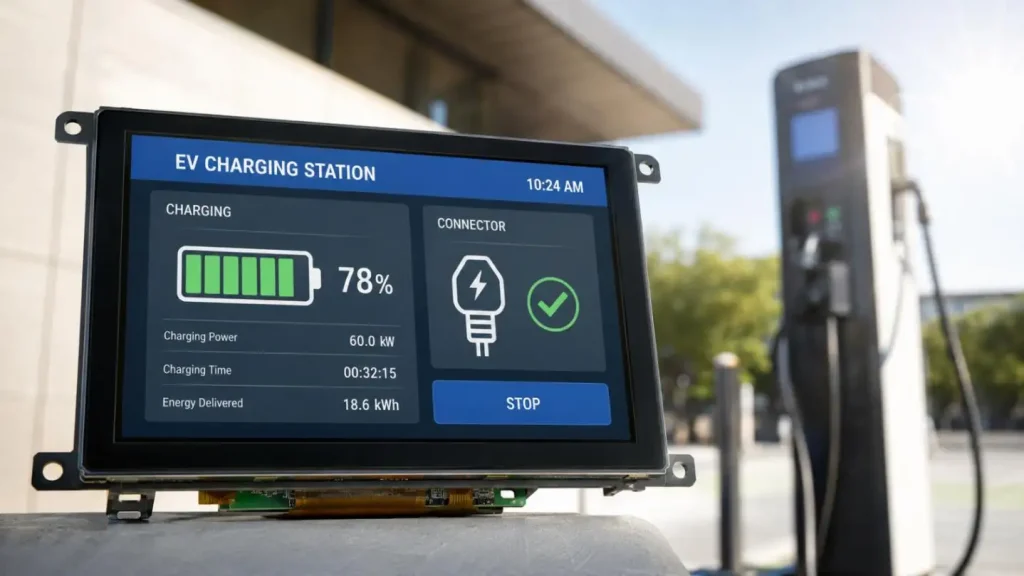
Sunlight Readability of the LCD Module is maintained by design with maximized contrast ratios at high ambient lighting conditions. Typical solutions addressed high backlight brightness of LEDs, transflective LCD technology, optical bonding, low reflection and anti-glare surface coatings, and auto brightness control.
High-brightness and transflective displays solve the same problem differently:
•A high-brightness LCD increases transmitted light from the backlight.
•A transflective LCD uses both internal backlight and reflected ambient light.
•The correct Sunlight Readable LCD Module depends on power availability, screen size, image requirements, operating temperature, installation angle, and outdoor exposure.
Sunlight readability should not be judged by brightness alone. A high nit rating measures emitted luminance under controlled conditions, but outdoor visibility depends primarily on the contrast that remains after ambient reflections are added.
The ambient contrast ratio can be expressed conceptually as:
ACR = (white-state luminance + reflected ambient light) ÷ (black-state luminance + reflected ambient light)
As reflected light increases, both white and black states appear brighter, reducing the visible difference between them. Therefore, an effective Sunlight Readable LCD Module must control both emitted light and reflected light.
Important parameters include:
•Typical and minimum luminance
•Surface reflectance
•Native contrast ratio
•Polarizer transmission
•Backlight uniformity
•Viewing angle
•Touch-panel structure
•Cover-glass thickness
•Operating temperature
•UV resistance
•Optical bonding method
A properly bonded 1,000-nit display may outperform a 1,500-nit air-bonded display if the latter produces excessive internal reflection.
A high-brightness TFT LCD uses an upgraded LED backlight to push more light through the rear polarizer, liquid-crystal layer, color filter, and front polarizer.
| Panel Brightness | Installation Environment | Typical Application |
| 300–500 nits | Controlled indoor lighting | Appliances and indoor meters |
| 600–800 nits | Bright indoor or semi-outdoor areas | Access control and vehicle displays |
| 1,000–1,500 nits | Outdoor equipment with partial shade | Industrial HMI and EV chargers |
| 1,500–2,500+ nits | Direct sunlight exposure | Kiosks and construction machinery |
Required brightness may change according to the user-interface color scheme, cover-glass reflectance, viewing distance, panel angle, and direction of sunlight.
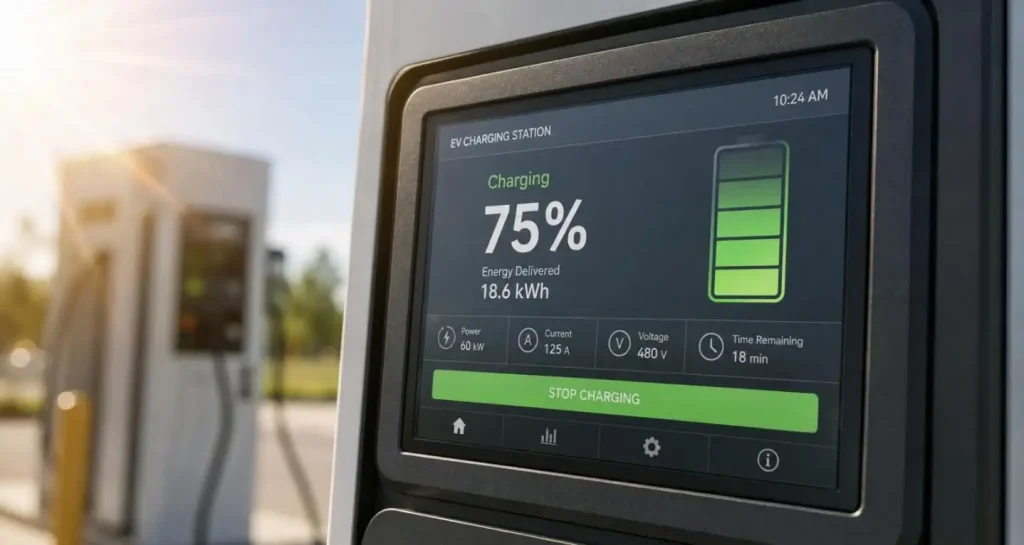
A high-brightness Sunlight Readable LCD Module normally combines:
•High-efficiency white LEDs
•Optimized light-guide plate patterns
•Diffuser films for luminance uniformity
•Prism films for forward light concentration
•Reflective films for light recycling
•Constant-current LED drivers
•PWM or analog dimming
•Aluminum backplates or thermal frames
Increasing LED current without redesigning the optical stack is inefficient. It can create bright spots, uneven luminance, excessive heat, and accelerated LED degradation.
•Better color saturation than most transflective displays
•Suitable for detailed graphics, camera images, and video
•Broad availability of IPS and high-resolution panels
•More options for medium and large display sizes
•Consistent image quality indoors, outdoors, and at night
•Higher backlight power demand
•Increased heat inside sealed enclosures
•Shorter LED life at continuous maximum current
•Possible thermal blackening of the liquid crystal
•Limited improvement if surface reflection remains high
A transflective display combines transmissive and reflective operating modes. Its pixel structure includes a partially reflective layer that allows backlight transmission while also reflecting incoming ambient light toward the viewer.
Displays rely on their internal backlight in low light environments. In fact, accounts for the external light source in the system. In combination with a transflective LCD Module designed for Sunlight Readability, this display would be visible without continuously driving the backlight to its maximum intensity.
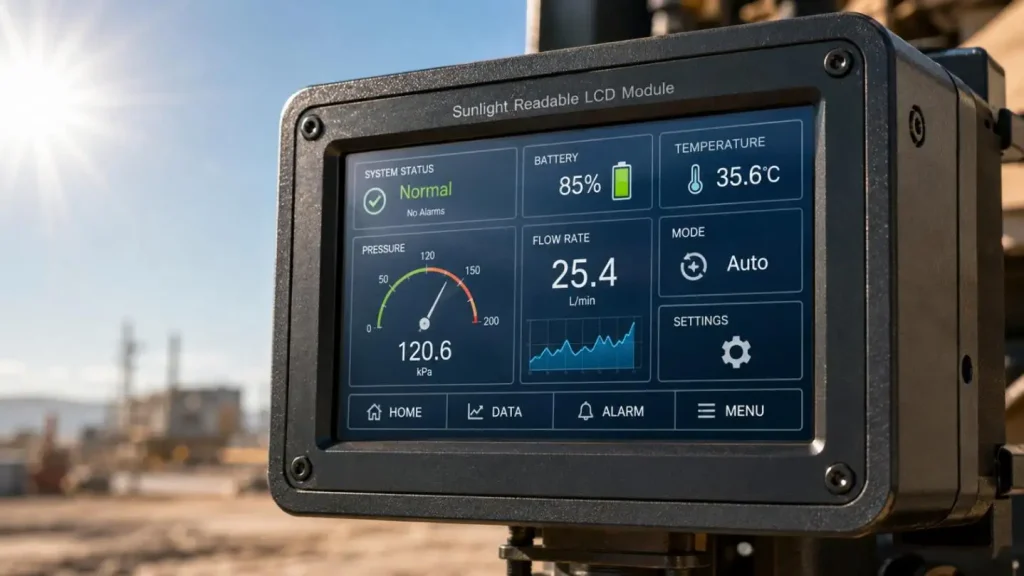
•High readability under direct sunlight
•Lower backlight power during daytime operations
•Less thermal load
•Longer battery operating time
•Good performance text, numbers, and simple graphics
•Well suited to compact instrumentation and outdoor devices that operate continuously
•Less color saturation under reflective mode
•Not well suited to video-rich interfaces
•Limited panel sizes and resolutions
•Very few options for wide-viewing-angle IPS displays
•More expensive unit configurations in certain applications
•Greater long-term supply risk for specialized panel models
| Technical Factor | High-Brightness LCD | Transflective LCD |
| Display principle | Strong transmitted backlight | Transmitted and reflected light |
| Direct-sun performance | Depends on luminance and reflection control | Improves as ambient light increases |
| Power consumption | Higher | Generally lower |
| Thermal output | Higher | Lower |
| Color performance | Stronger and more consistent | May appear muted outdoors |
| Video and GUI | Well suited | Better for simpler interfaces |
| Night operation | Excellent | Requires active backlight |
| Size availability | Broad | Relatively limited |
| Thermal design | More demanding | Less demanding |
| Typical equipment | Kiosks, HMIs, chargers | Meters, marine displays, handheld devices |
Choose a high-brightness Sunlight Readable LCD Module when the equipment:
•Has stable external power
•Uses detailed graphics or video
•Requires high color saturation
•Uses a medium or large display
•Has sufficient heat-dissipation capacity
•Must provide consistent daytime and nighttime image quality
Typical applications include outdoor kiosks, EV charging stations, industrial control systems, vehicle dashboards, commercial terminals, and heavy-equipment displays.
Choose a transflective Sunlight Readable LCD Module when the equipment:
•Is battery powered
•Operates outdoors for extended periods
•Displays mainly text, symbols, or numerical data
•Has limited enclosure space
•Requires low heat generation
•Uses a relatively small display
Common applications include marine instruments, portable test equipment, GPS terminals, agricultural monitors, outdoor sensors, and handheld controllers.
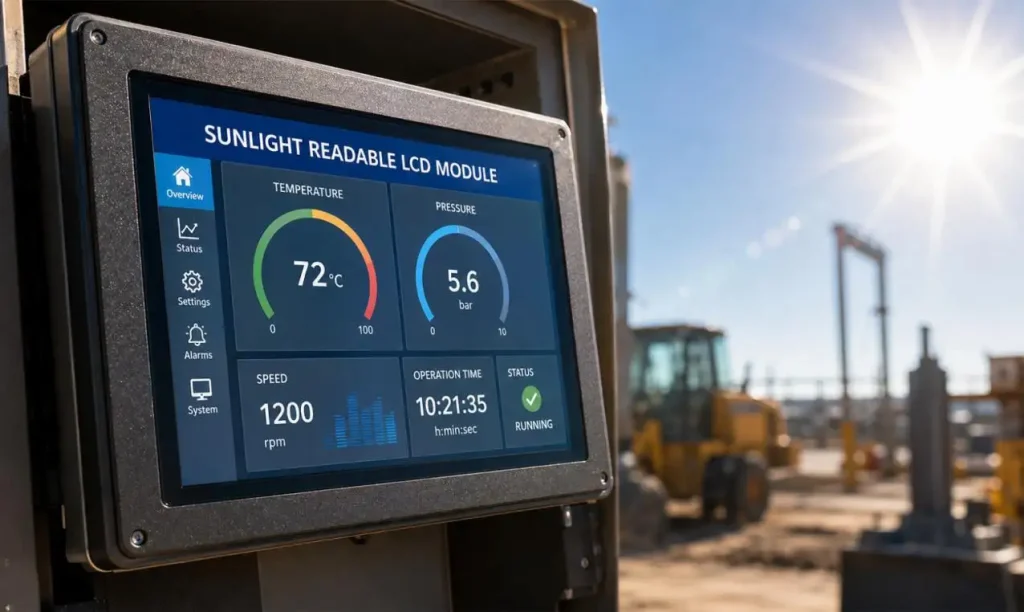
Optical bonding fills the air gap between the LCD, touch panel, and cover glass with transparent adhesive. This reduces refractive-index transitions and internal reflection.
Key benefits include:
•Higher ambient contrast
•Lower parallax
•Improved impact resistance
•Reduced condensation risk
•Better touch and display integration
| Treatment | Function | Design Risk |
| AR coating | Reduces specular reflection | Coating quality and durability |
| AG treatment | Diffuses glare | Excessive haze reduces sharpness |
| AF coating | Reduces fingerprints | Limited effect on sunlight reflection |
| Optical bonding | Removes internal reflective interfaces | Requires controlled adhesive thickness |
Polarizer orientation must also be reviewed for users wearing polarized sunglasses. An incorrect panel orientation can cause severe dimming or a nearly black display at certain viewing angles.
Direct sunlight can raise the display surface temperature far above ambient temperature. A high-brightness Sunlight Readable LCD Module should therefore be evaluated as part of the complete enclosure rather than as an isolated component.
Recommended measures include:
•Aluminum frames for heat conduction
•Ambient-light sensors for automatic dimming
•Temperature sensors with overheat protection
•Wide-temperature liquid-crystal materials
•Controlled LED current rather than permanent maximum drive
•Thermal simulation before enclosure finalization
•Ventilation, heat spreaders, or conductive mounting structures
High-brightness and transflective technologies offer different trade-offs in color, power, thermal performance, size availability, and outdoor readability.
For the control of industrial TFT LCD panels and Sunlight Readable LCD Module solutions, FaceLCD provides products for automotive electronics, inspection instruments, security terminals, medical devices and automation control, kiosks, smart devices, embedded HMI systems, and much more.
FaceLCD's custom products include high-brightness backlights, TN and IPS panels, capacitive and resistive touch panels, optical bonding, custom cover glasses, FPC modifications, driver boards, MCUs, RGB, LVDS, MIPI, eDP, or HDMI interfaces.
Write down the required size, resolution, brightness, interface, operating temperature, touch structure, and installation environment for FaceLCD to evaluate a Sunlight Readable LCD Module for your display system.
Q1. Which types of Sunlight Readable LCD Module does FaceLCD sell?
FaceLCD sells industrial TFT LCD solutions with standard-, high-brightness, and project-specific outdoor-readable configurations. Available options may include TN or IPS panels, touch integration, optical bonding, cover glass, and driver boards.
Q2. Does FaceLCD help in comparing high-brightness and transflective LCD technologies?
Yes. FaceLCD can assess the conditions of ambient-light, power budget, display size, interface requirements, thermal limitations, and the image-content needs to determine which technology is more suitable for the application.
Q3. What brightness levels does FaceLCD supply for outdoor displays?
Brightness depends on panel size and structure. FaceLCD provides standard indoor displays and high-brightness LCD modules designed for bright indoor, semi-outdoor, or direct sunlight environments.
Q4. Does FaceLCD offer optical bonding to provide sunlight readability for displays?
Yes. Optical bonding can be integrated between the TFT LCD, touch panel, and cover glass to reduce internal reflection, improve ambient contrast, decrease parallax, and support more robust outdoor display construction.
Q5. Does FaceLCD allow customization for the touch panel and cover glass?FaceLCD supports capacitive touch, resistive touch, and non-touch configurations. Cover glass can be customized by size, thickness, printed border, surface treatment, connector position, and mechanical structure.