
FaceLCD Hong Kong Limited
Tel: +8615818692944
E-mail: sales@facelcd.com
Address: 13F, Buiding B, Colorful Tech Park, Guanlan High tech park, Longhua Dist, Shenzhen,China ZIP code 518100
You are here: Home > Technology >
In industrial settings, the touchscreen acts as an interfacing bridge between the operators and the machines. To facilitate the control and monitoring of machines and to allow the operators to interact with the changing data, a TFT LCD Display for industrial use will usually embed a touch panel. It is also important to note that the various touch technologies will offer differentiating performance levels in factories, in the fields, in medical settings, and in commercial use.
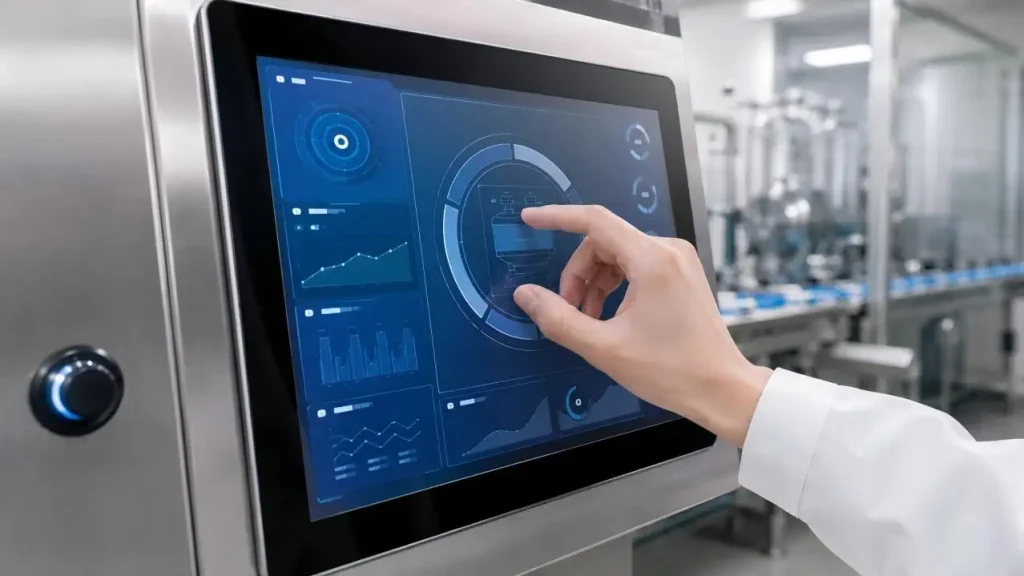
When opting for a specific touchscreen technology, the interaction, durability, and long-term reliability are to be evaluated based on how the technology will be used and the various environments in which it will be used. The following article offers comparisons of resistive, projected capacitive (PCAP), and infrared (IR) touch technologies, and how some manufacturers, such as FaceLCD, assess their use for industrial purposes.
The touchscreens used in industrial displays need to withstand the constant presence of dust, moisture, and interference. Industrial displays may also need to accommodate rapid temperature shifts, touch inputs by gloved hands, and a strong electromagnetic field.
In such use cases, the choice of touchscreen technology has a strong impact on:
•The reliability of inputs: Can operators successfully interact with the system using their hands, gloves, or other tools?
•System resilience: Can the system withstand the ingress of dust and liquids?
•The optical impact: Does the touch surface negatively impact the brightness and contrast of the display?
•Longevity of the System: Can the Interface Sustain Industrial Use?
Some design decisions can be used to help prevent input errors and improve system usability and system operation duration.
In touch technology, two flexible conductive layers are applied to a surface and interspaced by spacer dots. When a user interacts with the surface, the layers contact each other, and the system calculates the point of touch.
Because resistive touch screens utilize pressure rather than electrical conductivity to trigger the screen, just about any glove or pointed tool can operate the screen. This is useful in necessary defensive environments when the operator is using a protective glove.
2.Strong resistance to surface contamination
Since activation requires contact, some surface conditions such as dust, oil, and some non-conductive liquid contaminations will have a lesser effect.
3.Cost-effective solution
For applications that require a simple, reliable, and low cost solution, resistive touch panels are usually the best option.
4.Limitations
With resistive touch screens, some light transmission is lost due to the additional layers and the air gap. The flexible upper layer can also be scratched during heavy use.
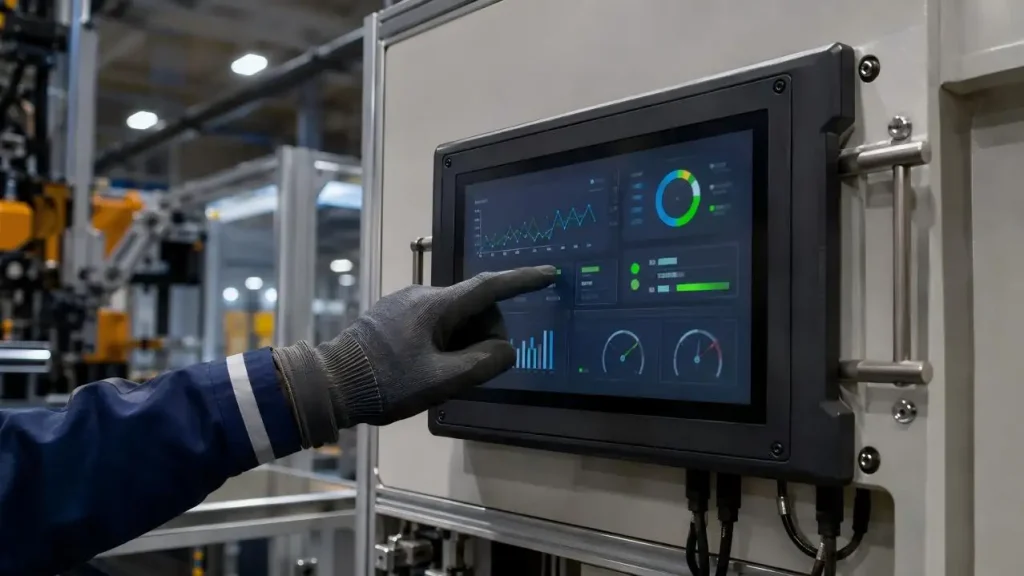
Projected capacitive (PCAP) touch technology identifies variations in electrostatic fields around its surface. It is common in modern industrial HMIs that require a higher quality user interface.
PCAP panels can be optically bonded directly to TFT LCD, minimizing internal reflections, and maintaining high brightness and contrast.
2.Multi-touch capability
PCAP allows numerous touch points and therefore enables gestures like zoom, scroll, swipe, etc., to be used in HMI designs.
3.Durable glass surface
The glass front surface is highly scratch resistant, and can withstand frequent cleaning, allowing its use in medical devices, food processing equipment, and public terminals.
4.Designing for the Industrial Market
PCAP technology is highly influenced by controller design and the surrounding environment. The presence of strongly conductive liquids or of high moisture and electromagnetic noise will influence the accuracy of PCAP technology. Thin, and possibly specially designed, industrial gloves may allow for some applications of PCAP technology. However, high insulating gloves will require other design considerations to be used effectively.
Infrared (IR) touch systems use infrared emitters and receivers installed around the display frame. When an object interrupts the infrared light path, the controller determines the touch position.
Since no touch film is placed over the display area, the TFT LCD maintains its original brightness and optical characteristics.
2.Flexible input methods
IR technology can detect fingers, gloves, styluses, and most solid objects without depending on electrical conductivity.
Suitable for large displays
IR touch is commonly used for larger industrial panels, interactive displays, and public information systems.
3.Limitations
The infrared sensing area around the bezel can be affected by dust, water droplets, insects, or physical obstruction. The required frame structure may also make ultra-thin or fully sealed designs more challenging.
| Factor | Resistive | Capacitive (PCAP) | Infrared |
| Activation Method | Physical pressure | electrical field detection | Infrared beam interruption |
| Glove Compatibility | Excellent | Variable depending on glove and controller | Excellent |
| Optical Quality | Average | Excellent | Excellent |
| Multi-Touch | Restricted | Excellent | Granted |
| Dust Protection | High | Average | Variable depending on bezel protection |
| Surface Durability | Average | Excellent with glass surface | Excellent with display |
| Common Uses | Industrial machines, control panels | Medical, automation, smart HMI | Large industrial displays, kiosks |
Choosing the right touch technology is heavily dependent on the working conditions and the needs of the user.
•For Heavy Industry:
Resistive or infrared touch technologies are preferred when the user is expected to wear heavy gloves or to use tools.
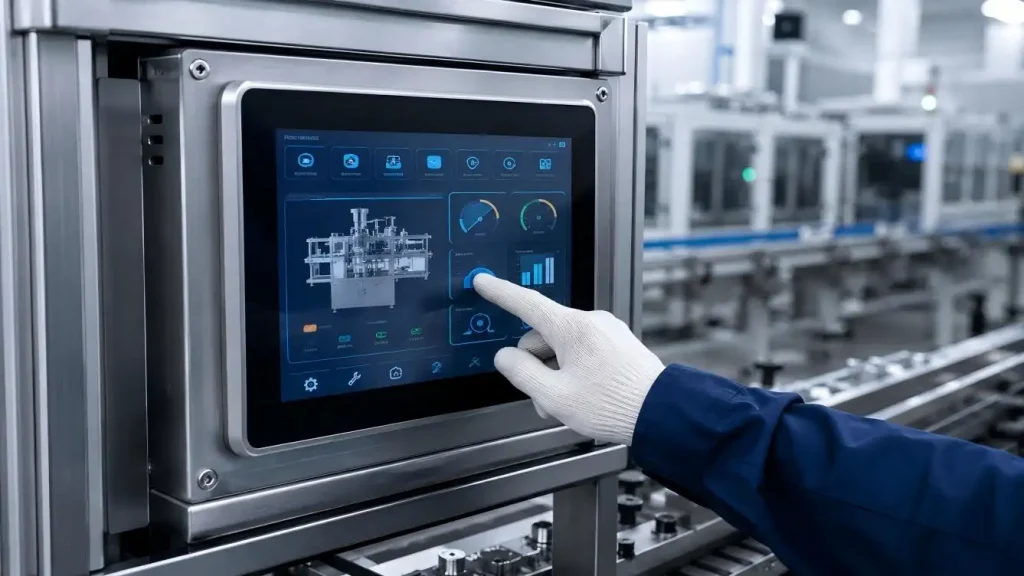
•For Medical and Hygiene:
PCAP touch technologies with a sealed glass surface, provide a modern UI and are easy to keep clean.
•For Outdoor Use and Sunlight Readable Displays:
When designing outdoor displays with a high degree of display brightness and infrared touch, a protective enclosure is required.
•For High EMI:
Grounding design, shielding and touch controller will need to be aligned with the TFT LCD module to ensure reliable operation.
FaceLCD believes that the best solution for touch technology is to tailor the solution based on the specific requirements of the industry rather than apply the same solution for all the projects.
As an illustration, a 10.1-inch 1280×720 IPS TFT LCD module can be offered with either resistive touch or capacitive touch depending on the needs for input, the target for optics, and the operating environment.
Some of the notable integration features include:
•Matching touch panels: Choosing appropriate touch panel structures based on the requirements of an application.
•Illumination Optimization: Analysis of the transmission loss of touch screens and backlit TFT LCDs.
•Temperature Reliability: Addressing the needs of touch screen industrial displays in the upper reaches of the extended temperature range of -30° to 80°C.
•Interface Integration: Combination of displays, backlights, and touch controllers.
•Customized HMI: Providing design flexibility from glove-operated to sophisticated industrial touch panels.
With application-centered engineering, customers of FaceLCD can realize the development of the TFT LCD Display for Industrial Equipment solutions with touch capability that is dependable.
A solution for touch technology that is the same across the board does not apply to every industrial project. For safe and reliable use in conjunction with gloves and tools, touch technology incorporating Resistive touch proves suitable, while PCAP, for enhanced optics and multi-touch, and Infrared, for touch and clear display, are excellent options available.
Ultimately, the correct touch technology for industrial TFT LCDs will rely on the conditions of the surrounding environment and the needs of the user with respect to maintenance. An integrated touch technology system ensures that the touch technology is dependable for a long time in the field.
Q1. Can infrared touchscreens be employed in outdoor settings?
Sure. While IR sensors should be protected from natural elements, infrared touch applications can be utilized for outdoor use.
Q2. What differentiates resistive and capacitive touchscreens?
Resistive technology requires physical touch, while capacitive technology recognizes touch through an electrostatic field that can be disrupted by a conductive body.
Q3. Do industrial touchscreens operate with gloves?
Certainly. Resistive and infrared touch technologies operate with the majority of glove types. The capability of PCAP technology is dependent on the glove type and the design of the controller.
Q4. Which touch technology has the advantage of better optical clarity?
Resistive solutions tend to have lower optical clarity in comparison to PCAP and infrared touch technologies.
Q5. Are PCAP touchscreens designed for the industrial market?
Certainly, PCAP technology is commonly found in industrial touch market applications such as HMIs that require high visibility and durable multi-touch functionality.