
FaceLCD Hong Kong Limited
Tel: +8615818692944
E-mail: sales@facelcd.com
Address: 13F, Buiding B, Colorful Tech Park, Guanlan High tech park, Longhua Dist, Shenzhen,China ZIP code 518100
You are here: Home > Technology >
Marine equipment builders need more than a standard outdoor screen. Salt-laden air, water droplets, corrosion, vibration, changing light conditions, gloves, and enclosure sealing can all affect display reliability. FaceLCD supports custom LCD, touch panel, cover glass, bonding, driver board, and display assembly projects for marine equipment manufacturers and system integrators.
The final configuration depends on where the display will be installed, how much water and salt exposure it will face, and whether the finished equipment requires a specific IP rating or marine approval. Send FaceLCD your enclosure drawing, target display size, interface requirements, and environmental specifications for an engineering review and quotation.
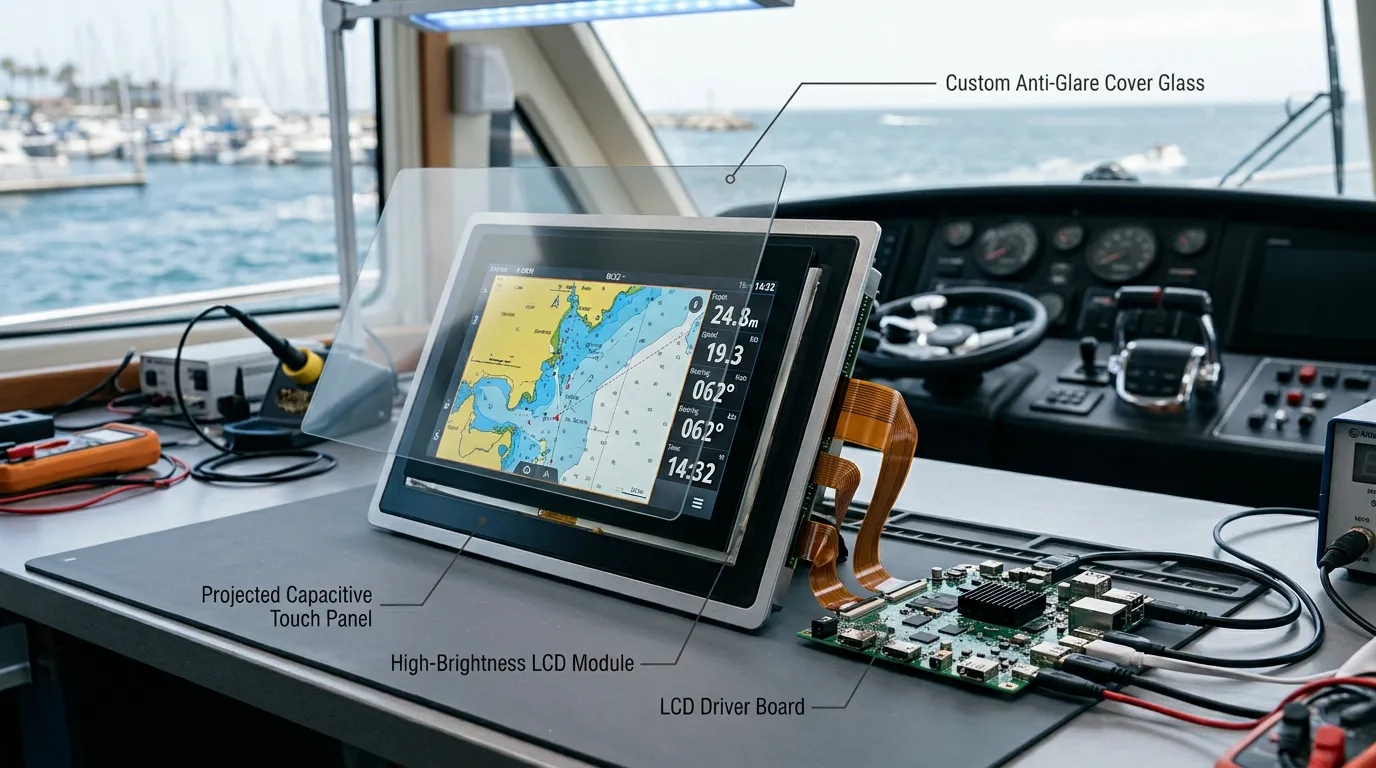
FaceLCD can review different product forms depending on how much of the display system your engineering team needs. A project may require only a custom touch panel, or it may need an LCD, touch layer, cover glass, controller, and driver board prepared as an integrated assembly.
FaceLCD manufactures custom display products ranging from 0.96 to 49 inches and supplies LCD modules, touch panels, driver boards, monitors, and all-in-one display systems. The correct marine configuration must still be selected and validated for the intended installation.
An outdoor capacitive touch screen may be designed for bright light, rain, water droplets, and outdoor temperature changes. A marine touch screen display may face additional risks from salt-laden humidity, splash exposure, corrosion-prone hardware, condensation, vibration, and continuous day-to-night operation.
| Design Area | Typical Outdoor Requirement | Additional Marine Requirement |
|---|---|---|
| Visibility | Readable in bright ambient light | May also require deep dimming for night operation |
| Water exposure | Rain or occasional droplets | Saltwater splash, wash-down, or exposed installation |
| Touch operation | Finger input | Wet fingers, water droplets, gloves, or stylus input |
| Sealing | Front weather protection | Defined protection for the front, rear, connectors, and cable entries |
| Materials | Weather-resistant exterior | Corrosion-resistant metals, coatings, fasteners, and interfaces |
| Testing | General environmental testing | Possible salt-mist, vibration, IP, or marine approval testing |
The installation area must be identified before the display is specified. A screen mounted inside a protected cabin may need a different design from one installed on an exposed deck, bridge wing, or outdoor control console.
Marine displays can operate under direct sunlight, reflected light from water, bright cabin windows, and low-light night conditions. Anti-glare treatment can reduce disruptive reflections, but it should not be treated as a complete sunlight-readability solution by itself.
The optical design should consider:
FaceLCD can review LCD brightness, cover-glass treatment, glass thickness, touch-stack construction, and bonding method as part of the project. The finished sample should be evaluated under the buyer’s actual daylight, cabin, dusk, and night conditions before mass production.
Water on a capacitive screen can affect touch accuracy or create unintended input. The required touch behaviour should therefore be defined more precisely than simply requesting a waterproof touchscreen.
Projected capacitive touch is suitable for modern glass-front HMIs and multi-touch interfaces. FaceLCD can review water-touch and glove-touch requirements, but performance depends on the selected touch controller, firmware, cover-glass thickness, glove material, and final display stack.
Resistive touch may be considered when pressure-based input, stylus operation, or broad glove compatibility is more important than multi-touch gestures. Buyers can review the wider selection process through FaceLCD’s industrial touch screen panel page.
| Touch Option | Suitable Applications | What Must Be Validated |
|---|---|---|
| Projected capacitive | Glass-front displays, gestures, and modern marine HMIs | Water behaviour, glove type, and false-touch rejection |
| Resistive | Pressure, stylus, and glove-based operation | Optical clarity, durability, and required input method |
| Non-touch display | Systems using physical controls for critical operation | Control layout and integration requirements |
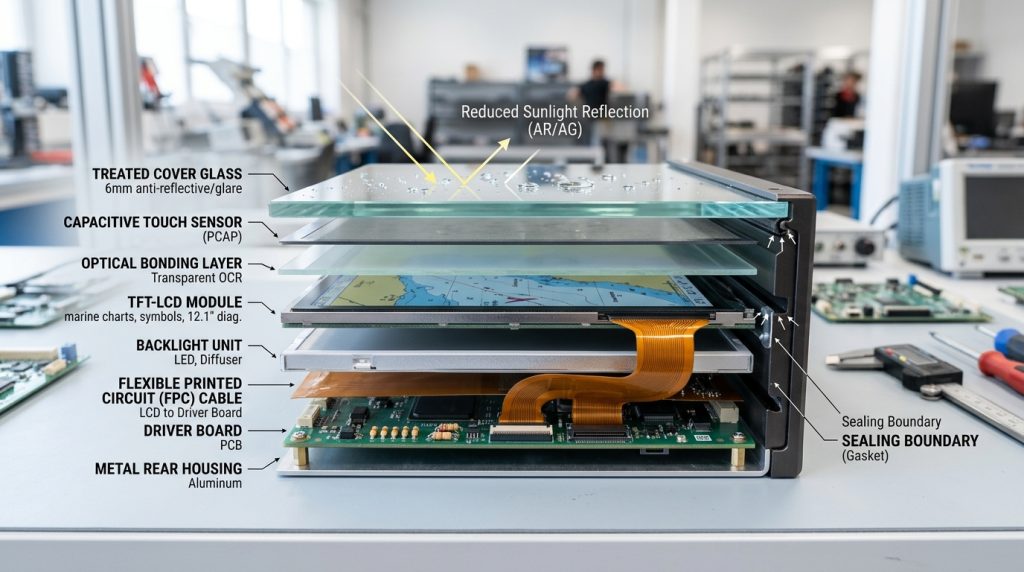
An IP-rated front structure does not automatically give the entire monitor or equipment assembly the same IP rating. The final result may also depend on the rear enclosure, connectors, cable entries, vents, fasteners, gaskets, and installation method.
The quotation and drawing should clearly identify:
Saltwater resistance is not determined by the touch glass alone. The complete design may need review of exposed metals, coatings, connectors, adhesives, fasteners, and enclosure joints.
Where salt-mist resistance is required, the buyer should provide the required standard, exposure duration, test conditions, and acceptance criteria. Relevant environmental methods may include IEC 60068-2-11 or IEC 60068-2-52, depending on the equipment and test plan.
FaceLCD should not be considered certified to a salt-mist standard unless a product-specific test report is available for the quoted configuration.
FaceLCD can review the display, touch panel, and cover glass against the buyer’s housing and installation drawing. Important dimensions include:
The display and touch system must match the equipment’s mainboard, power design, cable routing, and control method. Depending on the project, FaceLCD can review:
Projects requiring a monitor-level assembly rather than separate components can also review FaceLCD’s embedded touch screen monitor capabilities.
| Configuration Item | Possible Direction | Buyer Information Required |
|---|---|---|
| Product form | Touch panel, LCD-touch assembly, bonded module, or driver-board kit | Required supply boundary |
| Touch type | Capacitive or resistive | Finger, glove, stylus, and wet-use conditions |
| Cover glass | Custom outline, printing, thickness, and surface treatment | Drawing and appearance requirements |
| Bonding | Air bonding or optical bonding | Optical and environmental target |
| Display interface | Panel-native interface or matched driver board | Host output and cable constraints |
| Touch interface | USB, I2C, SPI, or custom connection | Mainboard and operating-system requirements |
| Sealing | Front-panel structure or wider assembly | Required IP boundary and test method |
| Corrosion protection | Project-defined materials and coatings | Exposure level and acceptance criteria |
Not every marine installation requires the same certification. A protected cabin control panel, an exposed deck display, and a navigation-system monitor may have different environmental and regulatory requirements.
Depending on the application, the buyer may need to specify:
These standards must not be treated as automatic features of a custom marine touch screen display. Required approvals should be identified before the LCD, touch controller, driver board, enclosure, and material system are finalized.
Marine certification, complete-unit IP protection, and salt-mist resistance are configuration-specific. Buyers should request the applicable test report or include third-party qualification in the project plan.
FaceLCD Hong Kong Limited was founded in 2009 and operates manufacturing facilities in Shenzhen and Dongguan. Its product scope includes TFT-LCD, STN, FSTN LCM, OLED, capacitive touch panels, resistive touch panels, driver boards, monitors, and all-in-one display machines.
Marine-specific project photos, salt-mist reports, complete-unit IP reports, wet-touch videos, or certification documents should be reviewed separately when they are required for supplier approval.
Send FaceLCD your display requirements and equipment drawings for a technical review. The engineering team can evaluate the LCD, touch panel, cover glass, bonding, driver board, interface, and mechanical fit for the intended marine application.
Yes. FaceLCD can review the LCD, capacitive or resistive touch panel, cover glass, bonding, FPC, connectors, interfaces, and driver board according to the project. The final configuration depends on the installation environment and required validation.
FaceLCD can review water-touch requirements for a capacitive design. Actual performance with droplets, wet fingers, or saltwater should be validated using the selected controller, glass stack, firmware, and sample.
Capacitive glove operation depends on the glove material, thickness, controller, and cover glass. Resistive touch may be considered when reliable pressure-based glove or stylus input is required.
Anti-glare surface treatment, custom cover glass, air bonding, and optical bonding can be reviewed as project requirements. The required optical performance should be defined before quotation.
An IP-rated front panel does not automatically make the complete monitor IP65 or IP67. The tested rating must identify the complete assembly, including the rear enclosure, connectors, cable entries, seals, and mounting method.
Certification should not be assumed. Buyers must identify the required standard before quotation and request valid product-specific certificates or include the necessary third-party testing in the project plan.
Verification may involve material and coating review, enclosure and connector inspection, sealing validation, and an agreed salt-mist test. The required test method, duration, and acceptance criteria must be defined for the project.
Depending on the selected components, FaceLCD can review LCD interfaces such as LVDS or eDP, matched driver-board inputs, and touch interfaces such as USB, I2C, or SPI.
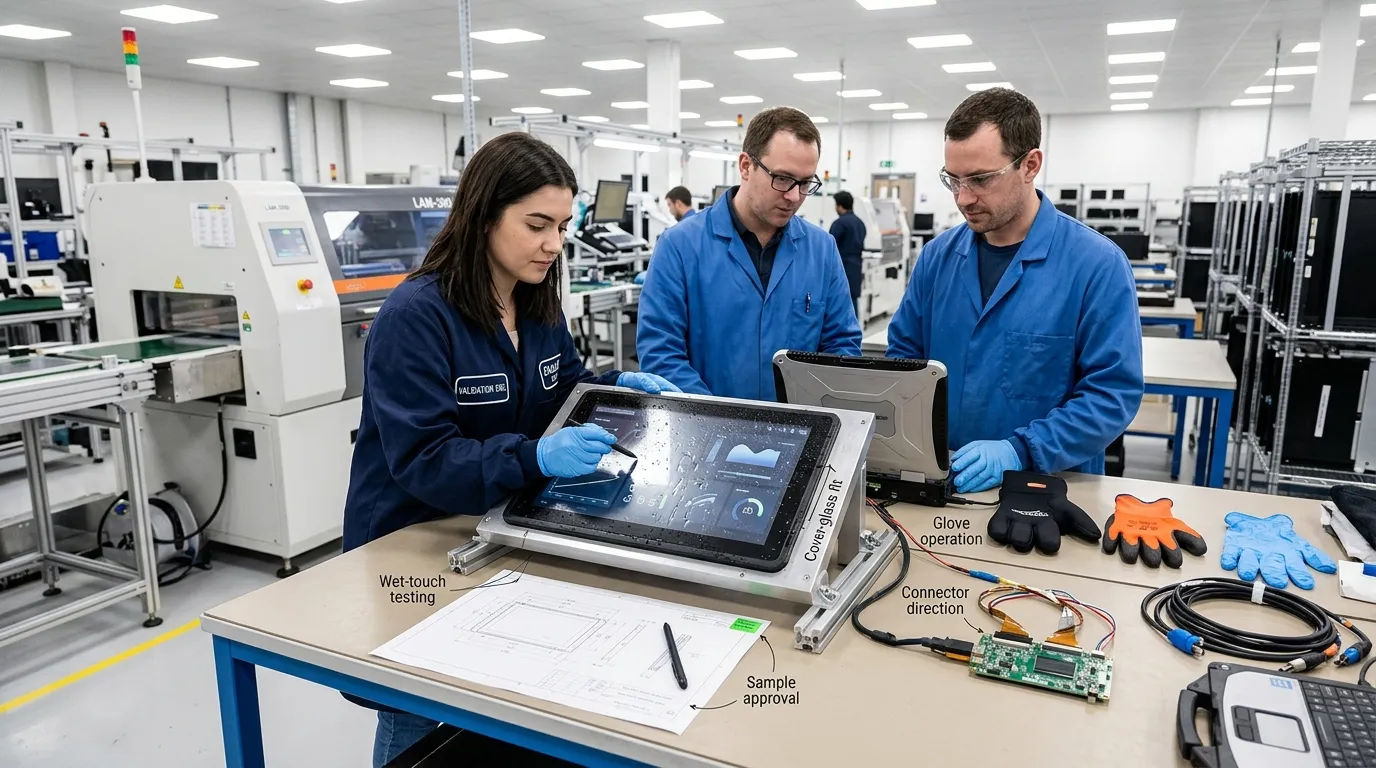
Yes. Sample validation should be completed before production, especially for wet touch, glove operation, brightness, dimming, temperature, vibration, sealing, salt-mist exposure, and interface stability.
Send the mechanical drawing, target display specification, host interface, optical requirements, touch conditions, environmental exposure, IP boundary, required tests, certification requirements, sample quantity, and estimated production volume.