
FaceLCD Hong Kong Limited
Tel: +8615818692944
E-mail: sales@facelcd.com
Address: 13F, Buiding B, Colorful Tech Park, Guanlan High tech park, Longhua Dist, Shenzhen,China ZIP code 518100
You are here: Home > Technology >
FaceLCD supplies compact LCD modules and custom touch display solutions for OEM and ODM projects. Its small-display portfolio starts at 0.96 inch and includes multiple formats up to 7 inches for handheld devices, smart controls, industrial equipment, medical systems, inspection tools, and embedded interfaces.
Depending on the selected LCD model and project structure, FaceLCD can evaluate capacitive touch, resistive touch, custom cover glass, FPC changes, connector matching, bonding, and optional driver-board support. Touch availability must be confirmed for each model, especially at the smallest screen sizes.
Send your LCD specification, enclosure drawing, PCB information, or required dimensions to FaceLCD for a model recommendation and quotation.
FaceLCD can supply individual display components or help develop a matched display assembly. The exact configuration depends on the selected LCD, input method, enclosure, controller, and application environment.
A capacitive touch configuration is suitable for products that require finger input, a glass front surface, and a modern user interface. Multi-touch and gesture support may be available depending on the touch controller and project requirements.
Before recommending a capacitive solution, FaceLCD should review the cover-glass thickness, touch interface, controller compatibility, grounding, glove requirements, water exposure, and electromagnetic environment.
A resistive touch panel can be more suitable when the screen must respond to pressure from a finger, glove, or stylus. It is commonly considered for compact industrial controls, portable instruments, and field equipment where precise pressure-based input is required.
The available resistive structure, FPC design, actuation method, and durability requirements must be confirmed for the selected display.
Not every compact device requires a touch panel. Products controlled by buttons, switches, knobs, or external input devices may use a display-only module with a custom front lens or cover glass.
This configuration can simplify integration while still allowing custom dimensions, printed borders, transparent windows, logos, icons, and mounting areas.
Depending on the project, FaceLCD can evaluate a complete assembly containing:
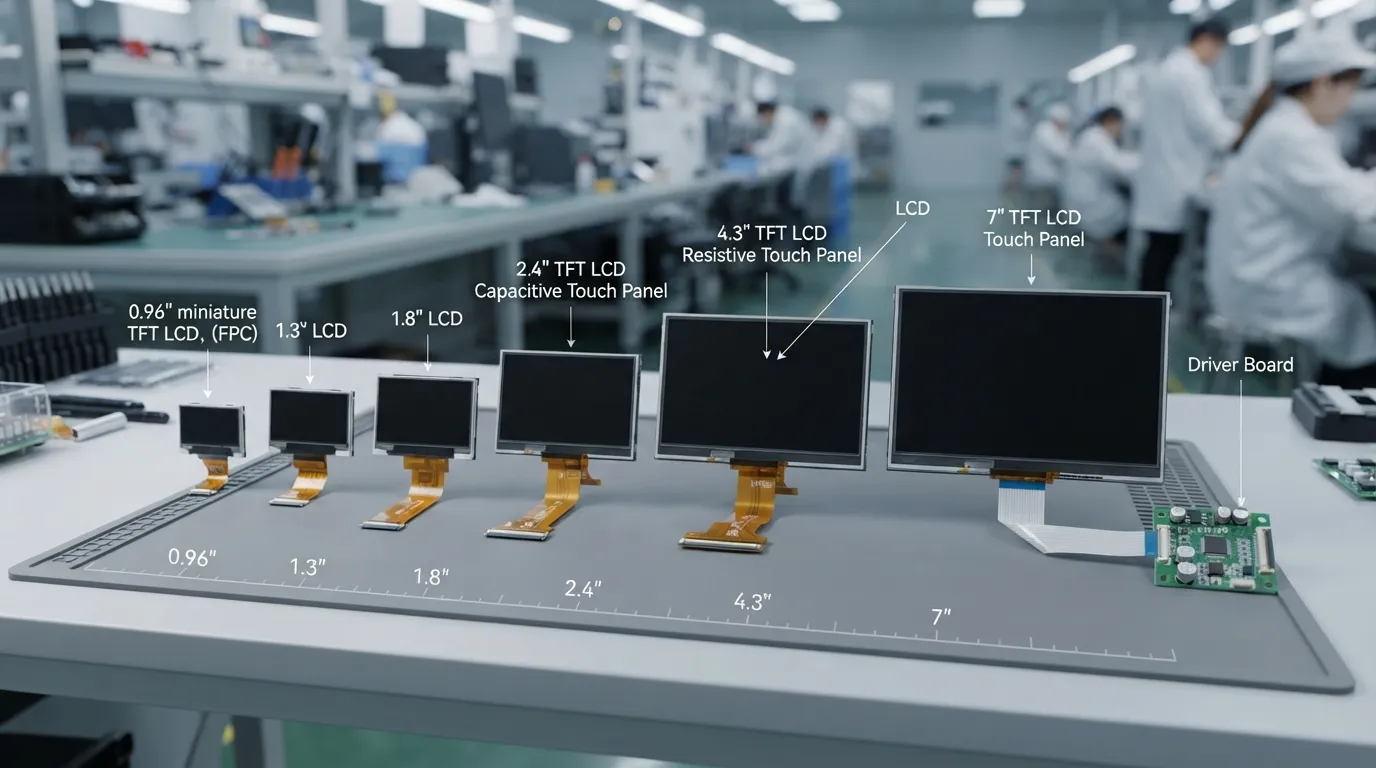
FaceLCD’s compact LCD portfolio begins at 0.96 inch and extends through multiple small and medium-small formats up to 7 inches. However, this does not mean that every size has a standard touch-enabled version. Touch feasibility should be checked according to the selected LCD model, active area, mechanical structure, and input requirements.
| Size Band | Representative Formats | Typical Project Fit | Touch Consideration |
|---|---|---|---|
| 0.96–2.1 inches | 0.96, 1.44, 1.47, 1.77, 2.0 and 2.1 inches | Status displays, sensors, handheld devices and compact controls | Confirm standard or custom touch feasibility for the specific model |
| 2.4–3.99 inches | 2.4, 2.86, 2.99, 3.2, 3.5, 3.9, 3.95, 3.97 and 3.99 inches | Portable instruments, smart appliances and compact controllers | Capacitive, resistive or non-touch options may be available depending on the module |
| 4.3–6.8 inches | 4.3, 4.6, 5, 5.7 and 6.8 inches | Industrial HMI, vehicle devices, test equipment and smart controls | Selected models may support standard or customized touch options |
| 7 inches | Multiple resolutions and interface configurations | Industrial controls, embedded systems, vehicle screens and HMI applications | Capacitive, resistive, USB-touch or display-only configurations may be evaluated |
A screen with the correct diagonal measurement can still be unsuitable for the product. The complete mechanical and electrical structure must be checked before a model is approved.
Important dimensions and specifications include:
A miniature status interface may only need icons, numbers, or a short menu. A compact touch interface requires enough active area for readable text and reliable touch targets. Larger 4.3-to-7-inch modules may be more suitable for full control pages, camera views, parameter settings, or industrial HMI layouts.
The display should therefore be selected according to both the enclosure and the amount of information users must view and control.
| Option | Best Fit | Main Advantages | Important Checks |
|---|---|---|---|
| Capacitive touch | Finger input, glass-front controls and modern interfaces | Smooth input and gesture support where configured | Controller, cover-glass thickness, gloves, water, grounding and EMI |
| Resistive touch | Glove, stylus, industrial or field operation | Pressure-based input and precise stylus control | Surface structure, actuation, FPC design and durability |
| Non-touch display | Devices using keys, knobs, switches or remote controls | Simpler integration with fewer components | Front lens, visible area, button layout and display interface |
FaceLCD can review the required display size, resolution, aspect ratio, LCD technology, brightness, viewing angle, operating environment, and electrical interface before recommending a module.
The available interface depends on the selected display. Possible interface families across the product range may include SPI, MCU, RGB, MIPI, LVDS, HDMI, or other model-specific configurations. Not every interface is available for every size.
Touch customization may include the touch structure, active area, controller, interface, FPC design, and operating behavior. Requirements involving gloves, water exposure, thick cover glass, or EMI should be discussed before sample development.
A custom cover glass can help the display fit the final product enclosure and visual design. Depending on feasibility, customization may include:
Projects requiring a specialized front-lens structure can also reference FaceLCD’s custom touch screen overlay service once that page is published and available.
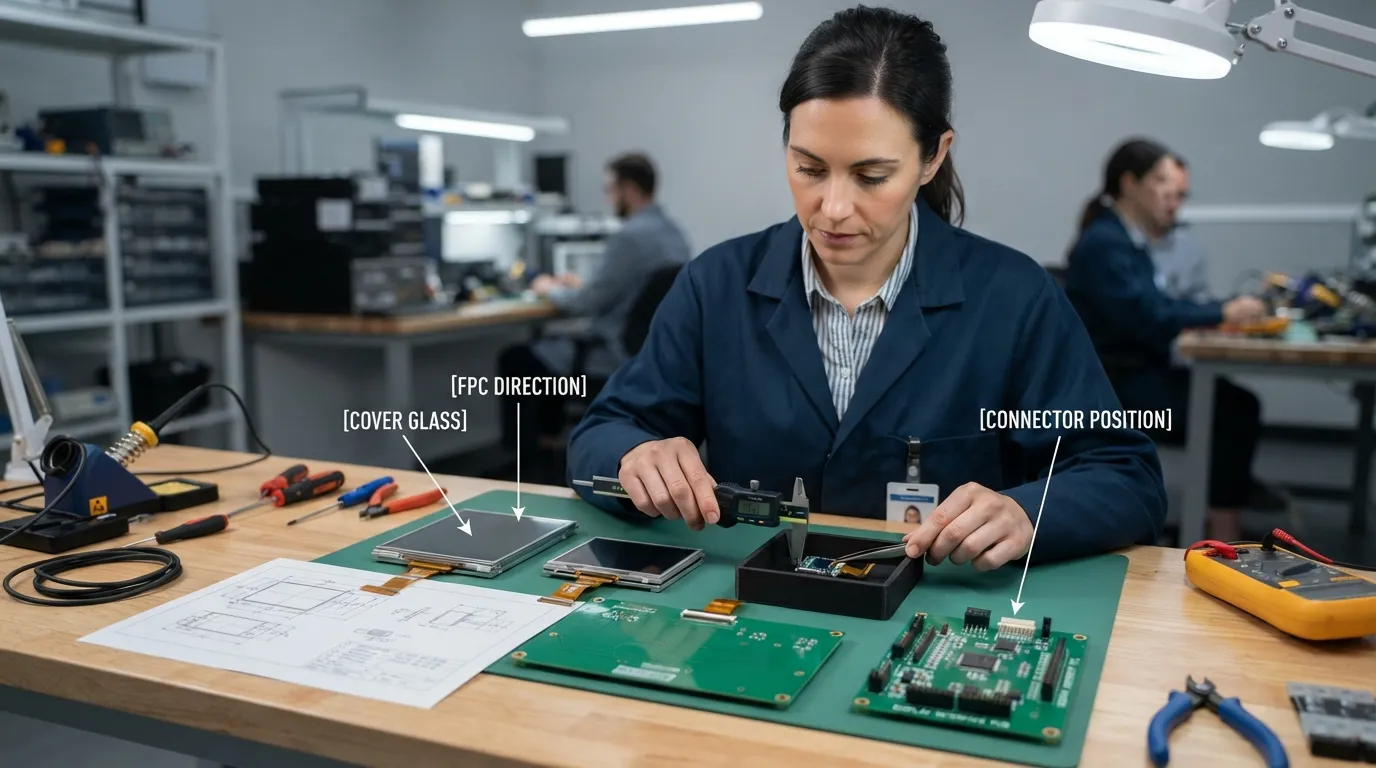
Compact products often have limited internal space. The direction and position of the FPC can be as important as the display size itself.
FaceLCD can review requirements involving:
The LCD, touch panel, and cover glass may be assembled using a structure appropriate for the project. Air bonding or optical bonding may be considered according to thickness, clarity, durability, operating environment, and cost requirements.
The final bonding method must be confirmed after reviewing the selected LCD, touch panel, cover glass, bezel, and enclosure structure.
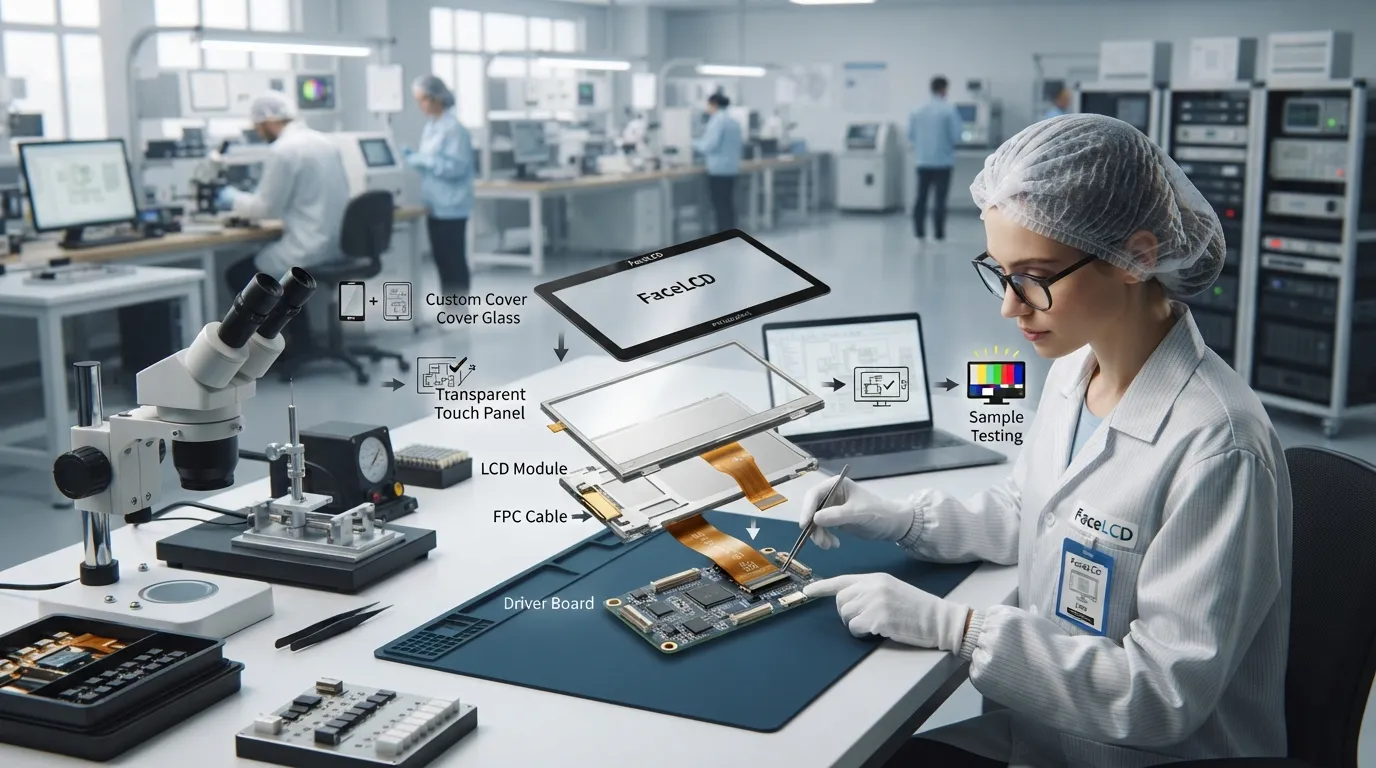
Provide the target display size, available space, resolution, interface, touch type, input method, mainboard, operating system, application environment, quantity, schedule, and available technical files.
FaceLCD evaluates whether an existing LCD fits the project, whether a standard touch panel is available, whether a custom touch panel is required, and whether a driver or conversion board may be needed.
The response should identify the proposed model, touch structure, custom items, required files, sample route, and commercial quotation.
The LCD outline, active area, touch area, cover-glass outline, FPC route, connector, printing, bonding, and mounting structure should be approved before sample production.
The buyer tests mechanical fit, display function, touch accuracy, interface communication, UI alignment, brightness, viewing angle, and any required glove, stylus, water, or EMI behavior.
After sample approval, the project can proceed to trial production and repeat ordering according to the confirmed specifications and commercial arrangement.
For projects with tight mechanical tolerances, early review of touch screen panel CAD drawings can help reduce alignment, enclosure, and tooling problems once the linked page is available.
| Risk | Possible Result | Review Point |
|---|---|---|
| Selecting by diagonal size only | The module does not fit the enclosure | Outline dimensions and mechanical drawing |
| Incorrect active-area alignment | The display or touch area is partly blocked | LCD, touch-panel and cover-glass drawings |
| Wrong FPC direction | The cable conflicts with the PCB or housing | FPC route and connector location |
| Interface mismatch | The display cannot communicate with the mainboard | LCD timing, interface, controller and board information |
| Wrong touch technology | Poor glove, stylus or gesture performance | Input method and operating environment |
| Incomplete cover-glass specification | Bezel, printing or mounting problems | Cover-glass CAD file and artwork |
| Skipping sample validation | Rework after tooling or production | System-level sample testing |
| Assuming every small LCD has touch | Delayed sourcing or product redesign | Model-specific touch feasibility review |
FaceLCD’s product scope includes LCD modules, touch panels, driver boards, monitors, and integrated display systems. Its compact LCD range begins at 0.96 inch and includes multiple TFT sizes suitable for embedded, portable, industrial, medical, automotive, smart-home, and inspection applications.
FaceLCD can evaluate more than the display panel alone. Depending on the project, the engineering review can include the LCD, touch panel, cover glass, FPC, connector, interface, driver support, mechanical drawing, sample, and final assembly requirements.
Relevant business and production strengths include:
Projects requiring broader custom-touch development can also review FaceLCD’s custom touch screen manufacturer capabilities once that page is live. Buyers sourcing capacitive touch panels in production quantities may also refer to the wholesale capacitive touch panels page when available.
Providing complete project information helps FaceLCD recommend a more suitable model and reduces unnecessary clarification during the quotation process.
Send FaceLCD your LCD specification, enclosure drawing, PCB information, or required dimensions to request a model recommendation, drawing review, sample, and quotation.
FaceLCD’s LCD portfolio starts at 0.96 inch. However, the minimum size available with standard or custom capacitive or resistive touch must be confirmed according to the selected model and project structure.
FaceLCD can review the LCD drawing, active area, touch area, cover glass, FPC, controller, interface, and enclosure before confirming whether a custom touch panel can be matched to the display.
Yes. The appropriate option depends on whether users operate the screen with a finger, glove, stylus, or mixed input, as well as the interface, cover-glass, environmental, and durability requirements.
FPC direction, length, pin definition, connector type, and connector position may be reviewed as part of the customization process. The buyer should provide PCB and enclosure information to confirm feasibility.
FaceLCD can evaluate a matched assembly containing the LCD, touch panel, cover glass, FPC, connector, and optional driver support. The final configuration depends on the selected module and approved drawings.
Yes, after reviewing the display interface, timing, voltage, connector, touch controller, operating system, and available mainboard documentation.
HDMI display input and USB touch may be available for selected modules or driver-board configurations. Availability must be confirmed for the required screen size and resolution.
Depending on feasibility, the cover glass may include custom dimensions, shape, border printing, logos, icons, transparent windows, and mounting areas.
The sample route depends on whether the project uses a standard module, a modified standard product, or a fully customized display assembly. Sample requirements should be included in the enquiry.
Provide the required size, resolution, interface, touch type, input method, mainboard, cover-glass requirements, FPC and connector details, application environment, quantity, schedule, and any available drawings or datasheets.